Historical Sources, Timeline & Prehistoric Indiaऐतिहासिक स्रोत, कालक्रम और प्रागैतिहासिक भारत
General Knowledge · Visual study guide with full explanationsसामान्य ज्ञान · चित्रों और पूरे विवरण के साथ अध्ययन मार्गदर्शिका
1. The Big Picture — Reading a Past That Cannot Speak1. बड़ी तस्वीर: उस अतीत को कैसे समझें जो बोल नहीं सकता
Imagine finding a broken clay pot in a field. The pot cannot tell you who made it. A historian therefore works like a careful detective: observe the clue, record where it was found, compare it with other clues, find its age, and only then build an explanation. Classify the object by material, form and layer as well as recording its exact context. An explanation remains open to revision when new evidence appears.मान लीजिए किसी खेत में मिट्टी के बर्तन का टूटा टुकड़ा मिला। वह खुद नहीं बता सकता कि उसे किसने बनाया था। इसलिए इतिहासकार सावधानी से सुराग जाँचता है: वस्तु को देखना, उसके मिलने की जगह दर्ज करना, दूसरे प्रमाणों से तुलना करना, उसकी उम्र जानना और फिर उसके आधार पर समझ बनाना। वस्तु का ठीक संदर्भ दर्ज करने के साथ उसका पदार्थ, रूप और परत के आधार पर वर्गीकरण करें। नया प्रमाण मिलने पर व्याख्या बदली जा सकती है।
One object needs a contextएक वस्तु को उसका संदर्भ चाहिए
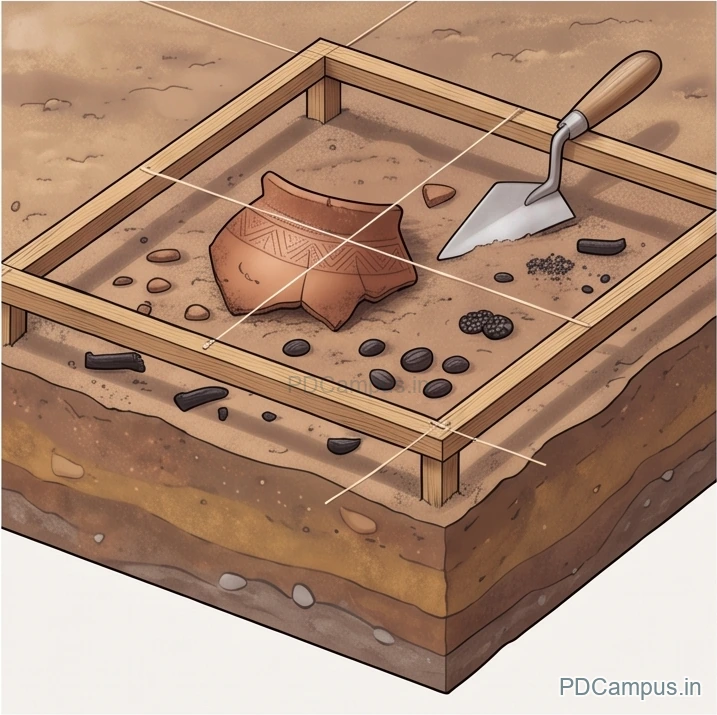
Central question: How can we reconstruct the past? Evidence: objects, buildings, inscriptions, coins, texts, images and living traditions. Time: sequence, approximate dates, scientific dates and regional overlap. People: food, work, technology, movement, art, ritual and social life. Places: rivers, rocks, climate, routes, resources and settlement sites. Historical explanation: cross-check many clues before drawing a conclusion.मुख्य सवाल: हम अतीत को कैसे समझ सकते हैं? प्रमाण: वस्तुएँ, इमारतें, अभिलेख, सिक्के, ग्रंथ, चित्र और जीवित परंपराएँ। समय: घटनाओं का क्रम, अनुमानित तारीखें, वैज्ञानिक काल-निर्धारण और क्षेत्रों में कालों का एक-दूसरे से मिलना। लोग: भोजन, काम, तकनीक, आवागमन, कला, अनुष्ठान और सामाजिक जीवन। स्थान: नदियाँ, चट्टानें, जलवायु, रास्ते, संसाधन और बस्तियाँ। ऐतिहासिक व्याख्या: निष्कर्ष निकालने से पहले कई प्रमाणों का मिलान करना।
Prehistoryप्रागैतिहासिक काल
The period before writing was available to record events. We learn mainly from tools, bones, seeds, ash, shelters, burials, art and environmental evidence.वह काल जब घटनाएँ दर्ज करने के लिए लेखन उपलब्ध नहीं था। इसे समझने के लिए मुख्य रूप से औजारों, हड्डियों, बीजों, राख, आश्रयों, दफन स्थलों, कला और पर्यावरण के प्रमाणों का सहारा लिया जाता है।
Before local writing, archaeology carries most of the work. Lack of readable writing can also describe protohistory, so this clue alone does not distinguish the two.स्थानीय लेखन से पहले के समय को समझने में पुरातत्त्व की मुख्य भूमिका होती है। पढ़े जा सकने वाले लेखन का अभाव आद्य-इतिहास में भी हो सकता है; इसलिए केवल इस आधार पर दोनों को अलग नहीं किया जा सकता।
Protohistoryआद्य-ऐतिहासिक काल
Protohistory is a bridge category. Its meaning varies: a society may have writing that cannot yet be read, or be described mainly by written records from neighbouring societies. The Harappan civilisation is a standard Indian example because its script has not been securely deciphered.आद्य-इतिहास बीच की एक श्रेणी है। इसका अर्थ संदर्भ के अनुसार बदलता है: किसी समाज का लेखन अभी पढ़ा नहीं जा सका हो, या उसके बारे में मुख्य लिखित जानकारी पड़ोसी समाजों से मिलती हो। भारतीय अध्ययन में हड़प्पा सभ्यता इसका सामान्य उदाहरण है, क्योंकि उसकी लिपि का अभी विश्वसनीय रूप से पाठ नहीं किया जा सका है।
There is writing, but it does not yet give us a readable story.लेखन मौजूद है, लेकिन उससे अभी पढ़ने योग्य विवरण नहीं मिलता।
Historyऐतिहासिक काल
The past for which readable written records can be used along with material evidence. The boundary is not the same everywhere because writing appeared and was deciphered at different times.अतीत का वह हिस्सा जिसके अध्ययन में भौतिक प्रमाणों के साथ पढ़े जा सकने वाले लिखित अभिलेख भी काम आते हैं। इसकी सीमा हर जगह समान नहीं है, क्योंकि लेखन का विकास और लिपियों का पढ़ा जाना अलग-अलग समय पर हुआ।
Readable writing joins archaeology; neither source should be used alone.पढ़ने योग्य लेखन पुरातत्त्व की जानकारी में जुड़ता है। किसी एक तरह के स्रोत पर ही निर्भर नहीं रहना चाहिए।
Chronology language — the ruler of historyकालक्रम की भाषा: इतिहास का समय-माप
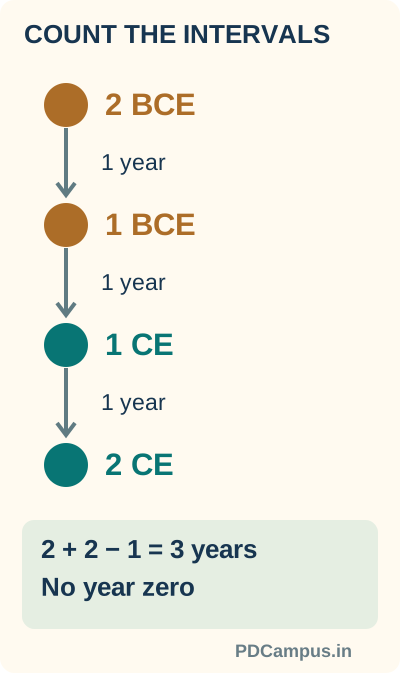
BCE Before Common Era 500 BCE → 100 BCE moves forward in time 1 BCE → 1 CE No year 0 CE Common Era 100 CE → 500 CE moves forward in timeBCE यानी सामान्य युग से पहले, जिसे यहाँ ईसा-पूर्व लिखा गया है। 500 ईसा-पूर्व → 100 ईसा-पूर्व समय में आगे बढ़ना है। 1 ईसा-पूर्व → 1 ईस्वी के बीच वर्ष 0 नहीं है। CE यानी सामान्य युग, जिसे यहाँ ईस्वी लिखा गया है। 100 ईस्वी → 500 ईस्वी भी समय में आगे बढ़ना है।
Century ruleशताब्दी का नियम
Years 1–100 are the 1st century. Years 101–200 are the 2nd century. Therefore, 622 CE belongs to the 7th century CE.वर्ष 1–100 पहली शताब्दी और 101–200 दूसरी शताब्दी हैं। इसलिए 622 ईस्वी सातवीं शताब्दी ईस्वी में आता है।
BCE feels reversedईसा-पूर्व की गिनती उलटी क्यों लगती है
In BCE, the larger number is earlier: 700 BCE happened before 300 BCE. The 6th century BCE covers 600–501 BCE.ईसा-पूर्व में बड़ी वर्ष-संख्या पहले का समय बताती है: 700 ईसा-पूर्व, 300 ईसा-पूर्व से पहले था। छठी शताब्दी ईसा-पूर्व में 600–501 ईसा-पूर्व आते हैं।
A timeline has no year zeroसमयरेखा में वर्ष शून्य नहीं है
Useful labelsकाम आने वाले संकेत
c. means circa, or approximately. BP means before present, with 1950 CE as the fixed reference year in conventional dating. ka means a thousand years and Ma means a million years; when used for an age here, they mean thousands or millions of years ago. A radiocarbon age in BP needs calibration before it becomes a calendar date.c. का अर्थ circa, यानी लगभग है। BP का अर्थ वर्तमान से पहले है, लेकिन परंपरागत काल-निर्धारण में इसका स्थिर आधार-वर्ष 1950 ईस्वी होता है। ka का अर्थ हजार वर्ष और Ma का अर्थ दस लाख वर्ष है; यहाँ उम्र बताते समय ये हजार या दस लाख वर्ष पहले के अर्थ में प्रयुक्त हैं। रेडियोकार्बन की BP उम्र को कैलेंडर की तारीख में बदलने से पहले कैलिब्रेशन करना पड़ता है।
The golden rule: A period label is a tool for organising evidence. It is not a bell that rang across the whole subcontinent on one morning.याद रखें: काल का नाम प्रमाणों को व्यवस्थित करने का तरीका है। ऐसा नहीं हुआ कि एक सुबह पूरे उपमहाद्वीप में एक काल समाप्त और दूसरा शुरू हो गया।
Dates are estimates of different kindsतारीखें अलग-अलग तरह के अनुमान बताती हैं
Chronology means arranging events in time. Relative dating says what is earlier or later; numerical dating estimates an age, normally with uncertainty. A century has 100 years and a millennium has 1,000. BCE and CE use the same year numbering as BC and AD. An age of 1.51 Ma is about 1,510,000 years, or 15.1 lakh years. Never read it as 1.51 lakh years.कालक्रम का मतलब घटनाओं को समय के क्रम में रखना है। सापेक्ष काल-निर्धारण बताता है कि क्या पहले और क्या बाद में हुआ। संख्यात्मक काल-निर्धारण उम्र का अनुमान देता है, जिसमें सामान्यतः कुछ अनिश्चितता रहती है। एक शताब्दी में 100 और एक सहस्राब्दी में 1,000 वर्ष होते हैं। BCE और CE की वर्ष-संख्या वही है जो BC और AD की है। 1.51 Ma का मतलब लगभग 1,510,000 वर्ष, यानी 15.1 लाख वर्ष है; 1.51 लाख वर्ष नहीं।
2. Sources and Dating — How a Clue Becomes Knowledge2. स्रोत और काल-निर्धारण: सुराग से जानकारी तक
A source is not the finished answer. It is a clue. Its meaning depends on where it was found, what survives, who created it, and whether other evidence supports the same idea.स्रोत अपने-आप में पूरा उत्तर नहीं है। वह एक सुराग है। उसका अर्थ इस पर निर्भर करता है कि वह कहाँ मिला, क्या बचा है, उसे किसने बनाया और क्या दूसरे प्रमाण भी वही बात बताते हैं।
Archaeological Remainsपुरातात्विक अवशेष
Tools, pottery, houses, food remains, beads, burials, monuments and layers of occupation.औजार, बर्तन, घर, भोजन के अवशेष, मनके, दफन स्थल, स्मारक और बसावट की परतें।
Archaeology studies material remains. The exact layer and location are called the context.पुरातत्त्व भौतिक अवशेषों का अध्ययन करता है। वस्तु की ठीक-ठीक परत और मिलने की जगह उसका संदर्भ कहलाती है।
Inscriptionsअभिलेख
Words engraved on stone, metal, pillars, caves, temple walls or terracotta.पत्थर, धातु, स्तंभ, गुफा, मंदिर की दीवार या पकी मिट्टी पर अंकित शब्द।
Epigraphy studies inscriptions. Palaeography studies the changing style of ancient writing. A praise inscription is a prashasti.अभिलेखों के अध्ययन को अभिलेखविद्या या एपिग्राफी कहते हैं। पुरानी लिखावट की बदलती शैली का अध्ययन पुरालिपिविद्या या पैलियोग्राफी है। किसी की प्रशंसा करने वाला अभिलेख प्रशस्ति कहलाता है।
Coinsसिक्के
A coin’s metal, weight, symbols, portrait, inscription (called its legend) and find-spot may reveal issuing authorities, monetary activity, religious imagery and exchange. A distant find may suggest movement or trade; one coin does not establish an entire trade route.सिक्के की धातु, वजन, चिह्न, आकृति, उस पर लिखा लेख और मिलने की जगह से जारी करने वाली सत्ता, मुद्रा के उपयोग, धार्मिक चित्रों और आदान-प्रदान की जानकारी मिल सकती है। दूर मिला सिक्का आवागमन या व्यापार का संकेत हो सकता है; एक सिक्के से पूरा व्यापार मार्ग सिद्ध नहीं होता।
Numismatics is the study of coins. A coin hoard must be dated by its whole context, not by one coin alone.सिक्कों के अध्ययन को मुद्राशास्त्र या न्यूमिस्मैटिक्स कहते हैं। एक साथ मिले सिक्कों के भंडार की तारीख उसके पूरे संदर्भ से तय करनी चाहिए, केवल एक सिक्के से नहीं।
Literary Sourcesसाहित्यिक स्रोत
Religious and secular texts, biographies, chronicles, law books, poems, dramas and administrative documents.धार्मिक और लौकिक ग्रंथ, जीवनियाँ, घटनाक्रम, कानून की पुस्तकें, कविताएँ, नाटक और प्रशासनिक दस्तावेज।
Ask who wrote the text, for whom, why, when, and whether the surviving copy is later than the original composition.पूछें: लेखक कौन था, उसने किसके लिए और क्यों लिखा, रचना कब बनी, और क्या बची हुई प्रति मूल रचना से बाद की है?
Oral, Visual and Living Traditionsमौखिक, दृश्य और जीवित परंपराएँ
Stories, songs, memories, rituals, craft traditions, paintings and community knowledge.कहानियाँ, गीत, स्मृतियाँ, अनुष्ठान, शिल्प-परंपराएँ, चित्र और समुदायों का ज्ञान।
They preserve voices that elite texts may ignore, but memory changes. Cross-check them with material and documentary evidence.इनसे उन लोगों की बातें भी मिल सकती हैं जिन्हें प्रभावशाली वर्गों के ग्रंथों में जगह नहीं मिली। लेकिन स्मृति बदलती है। इसलिए इन्हें भौतिक और दस्तावेजी प्रमाणों से मिलाकर देखें।
Environmental and Scientific Evidenceपर्यावरण और विज्ञान से मिलने वाले प्रमाण
Pollen, seeds, charcoal, animal bones, human remains, soils, sediments, isotopes and ancient DNA.परागकण, बीज, लकड़ी का कोयला, पशुओं की हड्डियाँ, मानव अवशेष, मिट्टी, तलछट, समस्थानिक और प्राचीन डीएनए।
These clues help reconstruct diet, climate, movement, plants, animals and the age of a deposit. Pollen is the fine powder produced by seed plants; sediments are particles deposited by water, wind or other processes. Isotopes are forms of an element with different neutron counts. Ancient DNA is surviving genetic material from old biological remains; it needs careful laboratory analysis and does not directly identify a person’s language or culture.इनसे भोजन, जलवायु, आवागमन, पेड़-पौधों, पशुओं और किसी जमाव की उम्र समझने में मदद मिलती है। परागकण बीज वाले पौधों में बनने वाले महीन कण हैं। तलछट वे कण हैं जिन्हें पानी, हवा या दूसरी प्रक्रियाएँ जमा करती हैं। समस्थानिक एक ही तत्व के वे रूप हैं जिनमें न्यूट्रॉन की संख्या अलग होती है। प्राचीन डीएनए पुराने जैविक अवशेषों में बची आनुवंशिक सामग्री है। इसके लिए सावधानी से प्रयोगशाला अध्ययन चाहिए; इससे किसी व्यक्ति की भाषा या संस्कृति सीधे पता नहीं चलती।
Specialists — who reads which clue?कौन-सा विशेषज्ञ कौन-सा प्रमाण पढ़ता है
| Specialist / methodविशेषज्ञ / विधि | Studiesअध्ययन की सामग्री | What it can revealक्या समझा जा सकता है |
|---|---|---|
| Archaeologistपुरातत्त्वविद् | Sites, layers and objectsस्थल, परतें और वस्तुएँ | Technology, settlement, economy and daily lifeतकनीक, बसावट, अर्थव्यवस्था और रोज का जीवन |
| Epigraphistअभिलेखविद् | Inscriptionsअभिलेख | Names, grants, orders, language, scripts and political claimsनाम, दान, आदेश, भाषा, लिपि और राजनीतिक दावे |
| Numismatistमुद्राशास्त्री | Coinsसिक्के | Authority, trade, metals, images and monetary activityसत्ता, व्यापार, धातुएँ, चित्र और मुद्रा का उपयोग |
| Archaeobotanistपुरावनस्पतिविद् | Seeds, grains, wood, pollen and phytoliths (tiny mineral bodies formed in plants)बीज, अनाज, लकड़ी, पराग और फाइटोलिथ यानी पौधों में बने सूक्ष्म खनिज कण | Crops, food, vegetation and farmingफसलें, भोजन, वनस्पति और खेती |
| Zooarchaeologistप्राणी-पुरातत्त्वविद् | Animal bones and shellsपशुओं की हड्डियाँ और खोल | Diet, hunting, herding and environmentभोजन, शिकार, पशुपालन और पर्यावरण |
| Bioarchaeologistजैव-पुरातत्त्वविद् | Human remainsमानव अवशेष | Health, age, diet, injury and sometimes mobilityस्वास्थ्य, उम्र, आहार, चोट और कभी-कभी आवागमन |
| Geologist / geoarchaeologistभूवैज्ञानिक / भू-पुरातत्त्वविद् | Rocks, soils, sediments and landformsचट्टानें, मिट्टी, तलछट और भू-आकृतियाँ | Landscape formation and site historyभूदृश्य का बनना और स्थल का इतिहास |
Dating methods — order first, calendar secondकाल-निर्धारण: पहले क्रम, फिर कैलेंडर
| Methodविधि | Simple ideaसरल विचार | Best used forकिसके लिए उपयोगी | Main cautionमुख्य सावधानी |
|---|---|---|---|
| Stratigraphyस्तर-विन्यास या स्ट्रैटिग्राफी | In an undisturbed deposit, a lower layer is normally older than a layer above it.बिना छेड़छाड़ वाले जमाव में निचली परत सामान्यतः ऊपर की परत से पुरानी होती है। | Relative order of occupations and objectsबसावट और वस्तुओं का पहले-बाद का क्रम | Pits, roots, animals and later digging can mix layers.गड्ढे, जड़ें, पशु और बाद की खुदाई परतों को मिला सकते हैं। |
| Typologyप्रकार-विज्ञान या टाइपोलॉजी | Arrange tools or pottery by changing shape, material and manufacture.औजार या बर्तन की बदलती बनावट, सामग्री और निर्माण के आधार पर क्रम बनाना। | Comparing styles and building sequencesशैलियों की तुलना और उनका क्रम | A style can continue for a long time or reappear.एक शैली लंबे समय तक रह सकती है या फिर लौट सकती है। |
| Radiocarbon / C-14रेडियोकार्बन / C-14 | After an organism dies, radioactive carbon decreases at a known rate.जीव के मरने के बाद रेडियोधर्मी कार्बन ज्ञात दर से घटता है। | Charcoal, seeds, wood, bone and other organic remains, generally up to about 50,000 yearsलकड़ी का कोयला, बीज, लकड़ी, हड्डी और अन्य जैविक अवशेष; सामान्यतः लगभग 50,000 वर्ष तक | It dates the sampled organism, not automatically every object nearby; contamination matters.यह नमूने वाले जीव की उम्र बताता है, पास की हर वस्तु की नहीं; बाहरी पदार्थ मिलना परिणाम बदल सकता है। |
| Thermoluminescenceताप-संदीप्ति या थर्मोल्यूमिनेसेंस | Heating empties stored energy in minerals; later laboratory heating measures energy accumulated since then.गरम होने पर खनिजों में फँसी ऊर्जा खाली होती है; प्रयोगशाला में दोबारा गरम करके उसके बाद जमा ऊर्जा मापी जाती है। | Fired pottery and burnt mineral materialपके बर्तन और आग से गरम हुई खनिज सामग्री | Needs suitable sampling and a secure relation to the event being dated.उपयुक्त नमूना और दिनांकित घटना से उसका पक्का संबंध जरूरी है। |
| OSL (optically stimulated luminescence)OSL: प्रकाश-प्रेरित संदीप्ति | Light resets energy in mineral grains; the test estimates when sediment was last exposed to light.प्रकाश खनिज कणों में संचित ऊर्जा को रीसेट करता है; जाँच बताती है कि तलछट आखिरी बार कब प्रकाश में आई। | Buried sand and sediment around artefactsवस्तुओं के आसपास दबी रेत और तलछट | Poor exposure before burial can affect the result.दफन होने से पहले पर्याप्त प्रकाश न मिला हो तो परिणाम प्रभावित हो सकता है। |
| Archaeomagnetismपुराचुंबकत्व | Heated clay can preserve the direction/intensity of Earth’s magnetic field at that time.गरम मिट्टी उस समय के पृथ्वी के चुंबकीय क्षेत्र की दिशा और तीव्रता संजो सकती है। | Hearths, kilns and burnt structuresचूल्हे, भट्टियाँ और जले हुए ढाँचे | Needs regional reference curves and undisturbed material.क्षेत्रीय संदर्भ आँकड़े और बिना हिली सामग्री चाहिए। |
The sample chooses the clockनमूने के अनुसार काल-निर्धारण
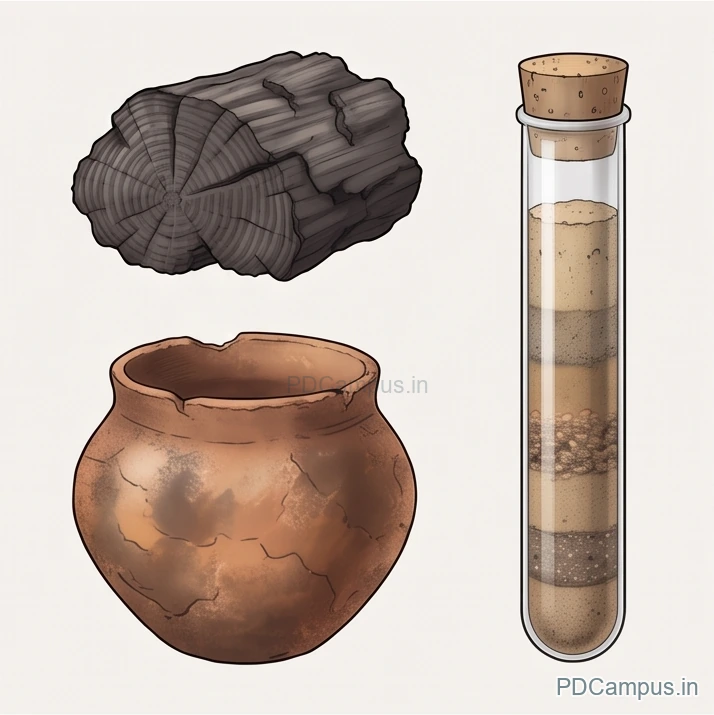
Choose the material before the methodपहले नमूना पहचानें, फिर विधि चुनें
Suppose a stone blade lies beside charcoal in a sealed hearth, a place where a fire was kept. Radiocarbon can date suitable charcoal; it cannot directly date the stone blade’s manufacture. Archaeologists must first establish that both belong to the same activity. Even charcoal may come from old wood. Calibration adjusts radiocarbon results against independently dated records because atmospheric carbon-14 has varied. The result is generally a calendar range, not a single certain year.मान लीजिए बिना छेड़छाड़ वाली परत में ढके मिले एक पुराने चूल्हे में पत्थर की धार के पास लकड़ी का कोयला मिला। उपयुक्त कोयले का रेडियोकार्बन परीक्षण हो सकता है; उससे पत्थर की धार बनने का समय सीधे नहीं मिलता। पहले यह जाँचना होगा कि दोनों एक ही गतिविधि से जुड़े हैं। कोयला भी पहले से पुरानी लकड़ी का हो सकता है। वायुमंडल में कार्बन-14 की मात्रा बदलती रही है, इसलिए परिणाम को स्वतंत्र रूप से दिनांकित अभिलेखों से मिलाकर सुधारा जाता है। इसे कैलिब्रेशन कहते हैं। आम तौर पर एक समय-सीमा मिलती है, कोई एक बिल्कुल निश्चित वर्ष नहीं।
Fact, inference and possibilityतथ्य, अनुमान और संभावना
Cut-marked bone observation → Tool cut meat inference → A hunting story? not provedहड्डी पर काटने के निशान: देखा गया प्रमाण → औजार से मांस काटना: प्रमाण से निकला अनुमान → शिकार की पूरी कहानी: अभी सिद्ध नहीं
One bone can show cutting. It cannot by itself tell us who hunted, who shared the food, or what ritual followed.एक हड्डी काटने का प्रमाण दे सकती है। उससे अकेले यह नहीं पता चलता कि किसने शिकार किया, किसने भोजन बाँटा या उसके बाद कौन-सा अनुष्ठान हुआ।
Cross-checkingअलग-अलग प्रमाणों का मिलान
Seeds Grinding stone Storage pit Field pollenबीज • पीसने का पत्थर • भंडारण का गड्ढा • खेत के परागकण
Several clues together can support crop processing and storage. However, people can grind and store wild plants too. A stronger case for farming also needs suitable crop evidence, such as changes associated with domestication, and a reliable context.कई प्रमाण मिलकर फसल के प्रसंस्करण और भंडारण की बात को मजबूत कर सकते हैं। लेकिन लोग जंगली पौधों को भी पीस और जमा कर सकते हैं। खेती का अधिक मजबूत निष्कर्ष निकालने के लिए उपयुक्त फसल-प्रमाण, जैसे पालतूकरण से जुड़े बदलाव, और विश्वसनीय संदर्भ चाहिए।
Source bias: A royal inscription may praise a victory and hide a defeat. A fragile basket may disappear while a stone axe survives. What survives is not a complete sample of life.स्रोत का पक्षपात: राजकीय अभिलेख जीत की प्रशंसा कर सकता है और हार छिपा सकता है। नाजुक टोकरी नष्ट हो सकती है, जबकि पत्थर की कुल्हाड़ी बच जाती है। बची हुई चीजें पूरे जीवन का संपूर्ण नमूना नहीं हैं।
3. Prehistoric Life — From Mobile Foragers to Farming Villages3. प्रागैतिहासिक जीवन: घूमते संग्राहकों से खेती वाले गाँवों तक
Early people did not suddenly “become civilised.” Across thousands of generations they learned new ways to find food, shape tools, use landscapes, care for groups, create art, grow plants and keep animals. Old and new ways often existed together.शुरुआती लोग अचानक “सभ्य” नहीं हुए। हजारों पीढ़ियों में उन्होंने भोजन पाने, औजार बनाने, परिवेश का उपयोग करने, समूह की देखभाल करने, कला रचने, पौधे उगाने और पशु पालने के नए तरीके सीखे। पुराने और नए तरीके अक्सर साथ-साथ चलते रहे।
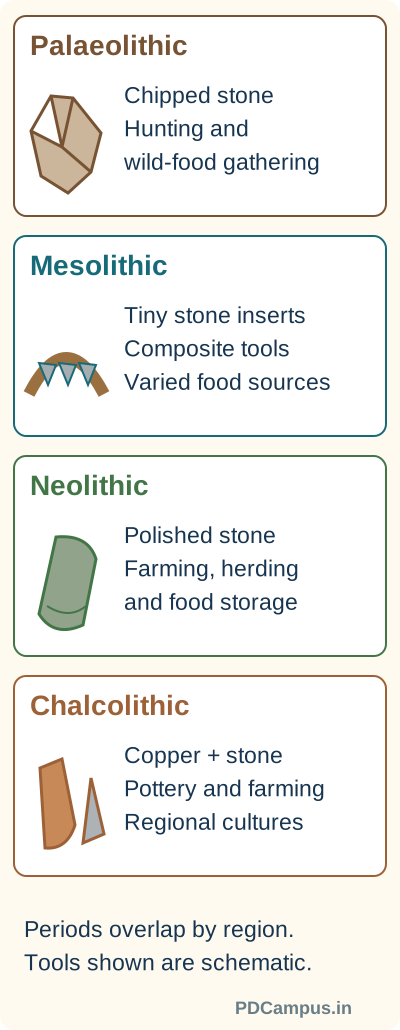
Palaeolithic — Old Stone Age: chipped stone tools; mobile hunting and gathering; a very long and regionally varied phase. Mesolithic — Middle Stone Age: tiny microliths, fishing, broader food use, rock art and more stable camps; begins around 10,000 BCE in the common Indian teaching frame. Neolithic — New Stone Age: food production, domestication, polished stone tools, pottery and settled villages; starts at different times in different regions. Chalcolithic — Copper-Stone Age: copper appeared but stone remained common; many communities were farming villages, not cities.पुरापाषाण यानी पुराना पाषाण युग: तराशे हुए पत्थर के औजार; घूमकर शिकार और संग्रह; बहुत लंबा और क्षेत्र के अनुसार बदलता काल। मध्यपाषाण यानी मध्य पाषाण युग: छोटे सूक्ष्मपाषाण औजार, मछली पकड़ना, भोजन के अधिक स्रोत, शैलचित्र और अधिक स्थिर पड़ाव; सामान्य भारतीय शिक्षण-क्रम में शुरुआत लगभग 10,000 ईसा-पूर्व मानी जाती है। नवपाषाण यानी नया पाषाण युग: खाद्य उत्पादन, पालतूकरण, घिसे-पॉलिश किए पत्थर के औजार, बर्तन और गाँव; शुरुआत हर क्षेत्र में अलग। ताम्रपाषाण यानी ताँबा-पत्थर युग: ताँबा आया, लेकिन पत्थर आम रहा; बहुत-सी बस्तियाँ खेती वाले गाँव थीं, नगर नहीं।
Food, tools and village life: first meaningsभोजन, औजार और गाँव: जरूरी शब्द
Foragers collect wild foods and hunt or fish. Farmers cultivate plants; herders manage animals. Domestication is a long process involving inherited changes in managed plant or animal populations, not merely taming one wild animal. A celt is a stone axe- or adze-like tool, often ground and polished; it is not a reference to the European Celtic peoples. A surplus is production beyond immediate needs; harvests did not always produce one.भोजन-संग्राहक जंगली खाद्य पदार्थ जुटाते हैं और शिकार या मछली पकड़ते हैं। किसान पौधे उगाते हैं; पशुपालक पशुओं की देखभाल करते हैं। पालतूकरण एक लंबी प्रक्रिया है जिसमें मानव देखरेख और चयन के बीच पौधों या पशुओं की पीढ़ियों में वंशानुगत बदलाव आते हैं। किसी एक जंगली पशु को वश में करना ही पालतूकरण नहीं है। सेल्ट पत्थर का कुल्हाड़ी या बसूले जैसा औजार है, जिसे अक्सर घिसकर चिकना किया जाता था। इसका यूरोप के सेल्टिक लोगों से संबंध नहीं है। तत्काल जरूरत से अधिक उत्पादन को अधिशेष कहते हैं; हर फसल में अधिशेष नहीं मिलता था।
Read a stone toolपत्थर के औजार को समझें
A core is the stone piece from which flakes are struck. A flake is a detached piece; a blade is a relatively long, narrow flake. A biface is worked on two faces. A handaxe has shaped cutting edges; a cleaver has a broad cutting edge; a chopper has an edge made by removing flakes. Scrapers work surfaces such as hide or wood. A burin has a chisel-like working point used for tasks such as engraving. These names describe form and technology: exact use needs wear marks and context, and no tool type belongs exclusively to one period.क्रोड वह पत्थर है जिससे चोट मारकर फलक निकाले जाते हैं। फलक अलग हुआ टुकड़ा है; अपेक्षाकृत लंबा और सँकरा फलक ब्लेड कहलाता है। द्विमुखी औजार को दोनों सतहों पर तराशा जाता है। हस्तकुठार में तराशी हुई काटने की धारें, विदारक में चौड़ी धार और चॉपर में फलक निकालकर बनाई गई धार होती है। खुरचनी से खाल या लकड़ी जैसी सतह पर काम किया जाता है। ब्यूरिन में छेनी जैसा काम करने वाला सिरा होता है, जिससे उकेरने जैसे काम हो सकते हैं। ये नाम बनावट और तकनीक बताते हैं। वास्तविक उपयोग जानने के लिए घिसाव और मिलने का संदर्भ भी चाहिए। कोई एक औजार केवल एक ही काल में नहीं मिलता।
Palaeolithicपुरापाषाण
Palaeo means old; lithic means stone. People depended mainly on hunting and gathering and moved as resources changed.पैलियो का अर्थ पुराना और लिथिक का अर्थ पत्थर है। लोग मुख्य रूप से शिकार और संग्रह पर निर्भर थे तथा संसाधन बदलने पर दूसरी जगह जाते थे।
- Lower: handaxes, cleavers, choppers.निम्न पुरापाषाण: हस्तकुठार, विदारक और चॉपर।
- Middle: flakes, points and scrapers.मध्य पुरापाषाण: फलक, नुकीले औजार और खुरचनियाँ।
- Upper: finer blades, burins and specialised tools.उच्च पुरापाषाण: अधिक महीन ब्लेड, ब्यूरिन और विशेष काम के औजार।
Mesolithicमध्यपाषाण
Meso means middle. Microliths are small chipped stone tools; the NIOS classroom description commonly gives a length of 1–8 cm. Different research traditions use narrower definitions. They could be fixed into wood or bone to make composite tools, meaning tools assembled from several parts, such as arrows, spears, sickles or knives.मेसो का अर्थ मध्य है। सूक्ष्मपाषाण या माइक्रोलिथ छोटे तराशे हुए पत्थर के औजार हैं। NIOS के सामान्य शिक्षण-विवरण में उनकी लंबाई प्रायः 1–8 सेमी दी गई है; शोध की अलग परंपराएँ अधिक संकरी परिभाषा अपना सकती हैं। इन्हें लकड़ी या हड्डी में लगाकर कई हिस्सों से बने संयुक्त औजार तैयार किए जा सकते थे, जैसे तीर, भाले, हँसिए या चाकू।
- Hunting and gathering continued.शिकार और संग्रह जारी रहे।
- Fishing and use of smaller animals grew.मछली और छोटे पशुओं का उपयोग बढ़ा।
- Some animal domestication and more stable camps appeared.कुछ जगह पशुओं का पालतूकरण और अधिक स्थिर पड़ाव दिखाई दिए।
Neolithicनवपाषाण
Neo means new. Communities increasingly produced food instead of only collecting it.नियो का अर्थ नया है। समुदाय केवल भोजन जुटाने के बजाय धीरे-धीरे उसका उत्पादन भी करने लगे।
- Farming and herding.खेती और पशुपालन।
- Ground and polished stone celts.घिसे और पॉलिश किए पत्थर के सेल्ट।
- Pottery in many phases, storage, weaving and houses; the earliest farming phases at some sites were without pottery.कई चरणों में बर्तन, भंडारण, बुनाई और घर; कुछ स्थलों के शुरुआती खेती वाले चरणों में बर्तन नहीं थे।
- Villages grew, but hunting still continued.गाँव बढ़े, लेकिन शिकार जारी रहा।
Chalcolithicताम्रपाषाण
Chalco means copper. Copper tools appeared beside stone blades and axes.चाल्को का अर्थ ताँबा है। पत्थर की धारों और कुल्हाड़ियों के साथ ताँबे के औजार भी दिखाई दिए।
- Mostly rural farming settlements.अधिकतर ग्रामीण खेती वाली बस्तियाँ।
- Regional pottery traditions.बर्तनों की क्षेत्रीय परंपराएँ।
- Mud houses and grain storage.मिट्टी के घर और अनाज का भंडारण।
- Herding, hunting and fishing remained important.पशुपालन, शिकार और मछली पकड़ना महत्वपूर्ण रहे।
The long Palaeolithic — tool technology changesलंबा पुरापाषाण काल: औजार बनाने की तकनीक में बदलाव
Lower Palaeolithic Heavy core tools and bifaces: handaxe, cleaver, chopper.निम्न पुरापाषाण: भारी क्रोड-औजार और द्विमुखी औजार; हस्तकुठार, विदारक और चॉपर।
These tools cut, split, scrape and dig. Acheulian means the handaxe-cleaver technological tradition found across Africa and Eurasia, including India.इनसे काटने, चीरने, खुरचने और खोदने जैसे काम किए जाते थे। अश्यूलियन उस हस्तकुठार-विदारक तकनीकी परंपरा का नाम है जो भारत सहित अफ्रीका और यूरेशिया में मिलती है।
Middle Palaeolithic Prepared flakes, points and scrapers.मध्य पुरापाषाण: पहले से तैयारी करके निकाले गए फलक, नुकीले औजार और खुरचनियाँ।
Toolmakers planned how a flake would break from a stone core. At Attirampakkam, this technological transition is dated much earlier than older textbooks once assumed.औजार बनाने वाले पहले सोचते थे कि पत्थर के क्रोड से फलक कैसे टूटेगा। अत्तिरमपक्कम में इस तकनीकी बदलाव की तारीख पुरानी पाठ्यपुस्तकों के अनुमान से बहुत पहले की मिली है।
Upper Palaeolithic Blades, burins, scrapers and specialised tools.उच्च पुरापाषाण: ब्लेड, ब्यूरिन, खुरचनियाँ और विशेष काम के औजार।
Longer, thinner blanks made efficient cutting edges. Art and ornaments become more visible at some sites, but preservation is uneven.लंबे और पतले टुकड़ों से उपयोगी काटने की धारें बनती थीं। कुछ स्थलों पर कला और आभूषण के प्रमाण अधिक दिखाई देते हैं, लेकिन हर जगह वस्तुएँ समान रूप से सुरक्षित नहीं बचीं।
From core to flake to composite toolक्रोड से फलक और फिर संयुक्त औजार
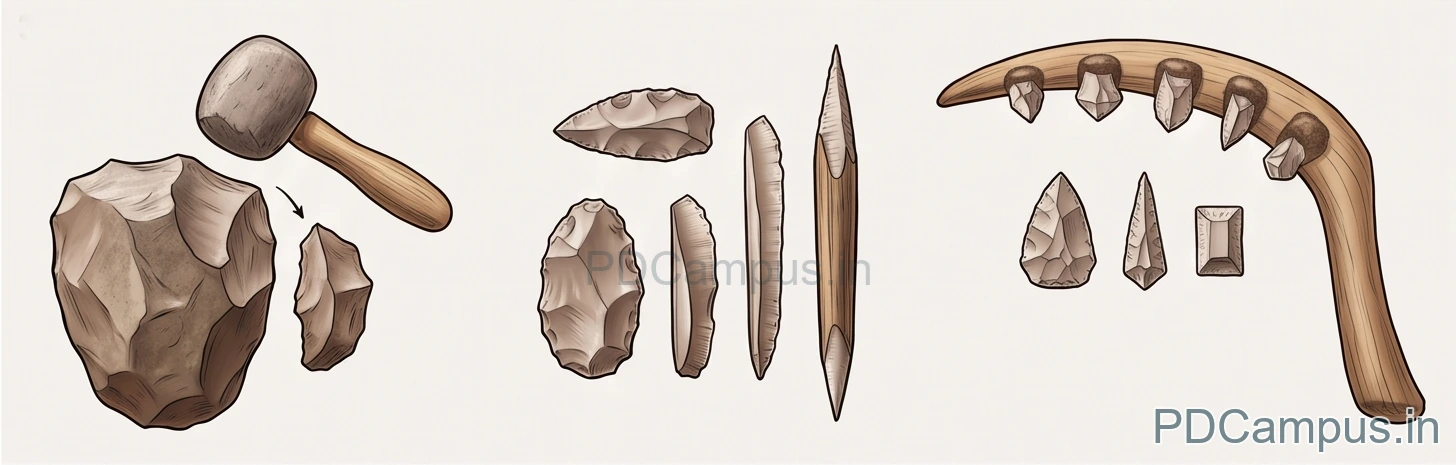
Older NIOS classroom material gives a broad Indian Palaeolithic span of about 500,000–10,000 BCE. It must not be treated as the earliest securely dated presence of this technology in India. Research at Attirampakkam reported a pooled average of about 1.51 ± 0.07 Ma for early Acheulian levels and a Middle Palaeolithic transition around 385 ± 64 ka, continuing there to about 172 ± 41 ka. The ± sign expresses the reported uncertainty, not an exact start or end day. These dates belong to that site; they are not one nationwide calendar.NIOS की पुरानी शिक्षण सामग्री भारतीय पुरापाषाण का सामान्य विस्तार लगभग 500,000–10,000 ईसा-पूर्व बताती है। इसे भारत में इस तकनीक की सबसे शुरुआती विश्वसनीय तारीख नहीं मानना चाहिए। अत्तिरमपक्कम के शोध में शुरुआती अश्यूलियन परतों की संयुक्त औसत उम्र लगभग 1.51 ± 0.07 Ma और मध्य पुरापाषाण में बदलाव लगभग 385 ± 64 ka बताया गया है; वहाँ मध्य पुरापाषाण लगभग 172 ± 41 ka तक चलता रहा। ± चिह्न बताई गई अनिश्चितता दर्शाता है, कोई निश्चित आरंभ या अंत का दिन नहीं। ये उस स्थल की तारीखें हैं, पूरे देश का एक कैलेंडर नहीं।
Who made the tools?औजार किसने बनाए
Hominin is the broad scientific word for humans and our close evolutionary relatives after the split from the lineage leading to living chimpanzees. Homo is the genus that includes species such as Homo erectus and our species, Homo sapiens. A genus groups related species. Pleistocene is a geological time division that overlaps much of the Palaeolithic; it describes Earth history rather than one tool tradition.होमिनिन वैज्ञानिक शब्द है। इसमें मनुष्य और वे निकट विकासवादी संबंधी आते हैं जो जीवित चिंपैंजी की ओर जाने वाली वंश-रेखा से अलग होने के बाद हमारी शाखा में हुए। होमो एक वंश का नाम है, जिसमें होमो इरेक्टस और हमारी प्रजाति होमो सेपियन्स जैसी प्रजातियाँ आती हैं। वंश संबंधित प्रजातियों का समूह होता है। प्लीस्टोसीन भूवैज्ञानिक समय का एक भाग है, जो पुरापाषाण के बड़े हिस्से से मिलता है। यह पृथ्वी के इतिहास का काल है, किसी एक औजार-परंपरा का नाम नहीं।
In much of India, stone tools survive but the makers’ bones do not. A tool type alone cannot prove the exact species that made it.भारत के बहुत-से हिस्सों में पत्थर के औजार बचे हैं, पर बनाने वालों की हड्डियाँ नहीं। केवल औजार के प्रकार से निर्माता की सही प्रजाति सिद्ध नहीं होती।
The Narmada clueनर्मदा का प्रमाण
A hominin cranial fossil, meaning a preserved part of a skull, found at Hathnora in the Narmada valley is one of India’s important prehistoric human remains. Its taxonomic classification, or assignment to a species, has been debated. Its age is also difficult to establish because deposits can contain material of different ages.नर्मदा घाटी के हथनौरा से मिला होमिनिन कपाल-जीवाश्म, यानी खोपड़ी का सुरक्षित बचा हिस्सा, भारत के महत्वपूर्ण प्रागैतिहासिक मानव अवशेषों में है। उसका वर्गिकी निर्धारण, यानी किस प्रजाति में रखा जाए, विवाद का विषय रहा है। उम्र तय करना भी कठिन है, क्योंकि जमाव में अलग-अलग समय की सामग्री मिल सकती है।
A real fossil exists; the safest accurate statement is that its precise species identification is not settled.जीवाश्म वास्तविक है; सावधानी से कहा जाए तो उसकी ठीक-ठीक प्रजाति की पहचान तय नहीं है।
From collecting food to producing foodभोजन जुटाने से भोजन उगाने तक
| Featureविशेषता | Palaeolithicपुरापाषाण | Mesolithicमध्यपाषाण | Neolithicनवपाषाण | Chalcolithicताम्रपाषाण |
|---|---|---|---|---|
| Main food systemमुख्य भोजन व्यवस्था | Hunting and gatheringशिकार और संग्रह | Hunting-gathering, fishing; early herding in some placesशिकार-संग्रह, मछली पकड़ना; कुछ जगह शुरुआती पशुपालन | Farming and herding, with hunting still presentखेती और पशुपालन; शिकार भी | Farming, herding, hunting and fishingखेती, पशुपालन, शिकार और मछली पकड़ना |
| Toolsऔजार | Chipped core, flake and blade toolsतराशे हुए क्रोड, फलक और ब्लेड | Microliths, often set in handlesसूक्ष्मपाषाण; अक्सर हत्थों में लगाए गए | Ground/polished celts plus stone and bone toolsघिसे-पॉलिश किए सेल्ट तथा पत्थर और हड्डी के औजार | Copper objects plus stone blades and axesताँबे की वस्तुएँ तथा पत्थर की धारें और कुल्हाड़ियाँ |
| Settlementबसावट | Mostly mobile camps and sheltersअधिकतर घूमते पड़ाव और आश्रय | Seasonal or more stable campsमौसमी या अधिक स्थिर पड़ाव | Villages, houses and storageगाँव, घर और भंडारण | Mostly rural planned or semi-planned villagesअधिकतर ग्रामीण, कुछ नियोजित या आंशिक नियोजित गाँव |
| Other signsअन्य संकेत | Fire, butchery, tool manufactureआग, मांस काटना, औजार बनाना | Rock art, burials, fishing, composite toolsशैलचित्र, दफन, मछली पकड़ना, संयुक्त औजार | Pottery in many phases, weaving, domestication and storage; surplus variedकई चरणों में बर्तन, बुनाई, पालतूकरण और भंडारण; अधिशेष अलग-अलग | Regional pottery, craft skill, exchange and social differencesक्षेत्रीय बर्तन, शिल्प, आदान-प्रदान और सामाजिक अंतर |
Work around a farming villageखेती वाले गाँव के काम
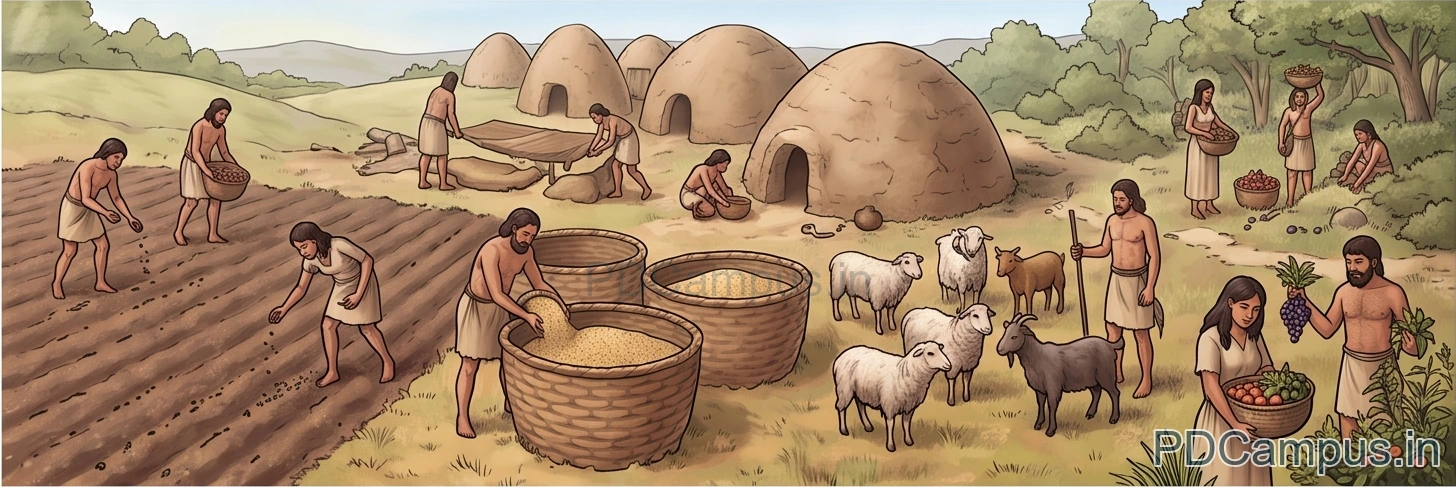
Why farming changed daily workखेती ने रोज के काम कैसे बदले
Sowing, protecting crops and waiting for a harvest encouraged people to remain near fields. Storage helped carry food across seasons and created work such as making containers and protecting grain. Herds supplied food and other materials but needed water and pasture. Farming could support larger settlements, yet it also brought risks from failed crops and concentrated living. People continued hunting, fishing, collecting and exchanging food. “Neolithic Revolution” names the scale of this change; it does not mean it happened suddenly or everywhere together. Fire helped people cook, keep warm and manage materials; evidence for its use must be dated at each site rather than assigned one universal invention date.बीज बोना, फसल बचाना और कटाई की प्रतीक्षा करना लोगों को खेतों के पास रहने के लिए प्रोत्साहित करता था। भंडारण से एक मौसम का भोजन आगे काम आ सकता था। इसके लिए पात्र बनाना और अनाज सुरक्षित रखना भी जरूरी हुआ। पशुओं से भोजन और दूसरी सामग्री मिलती थी, पर उनके लिए पानी और चरागाह चाहिए थे। खेती से बड़ी बस्तियाँ चल सकती थीं, लेकिन फसल खराब होने और घनी आबादी में रहने के जोखिम भी थे। शिकार, मछली पकड़ना, संग्रह और भोजन का आदान-प्रदान चलता रहा। “नवपाषाण क्रांति” बदलाव के बड़े प्रभाव को बताती है; इसका मतलब अचानक या हर जगह एक साथ हुआ बदलाव नहीं है। आग से भोजन पकाने, गर्म रहने और सामग्री पर काम करने में मदद मिली। उसके उपयोग का प्रमाण हर स्थल पर अलग जाँचना चाहिए; आविष्कार की एक सार्वभौमिक तारीख नहीं देनी चाहिए।
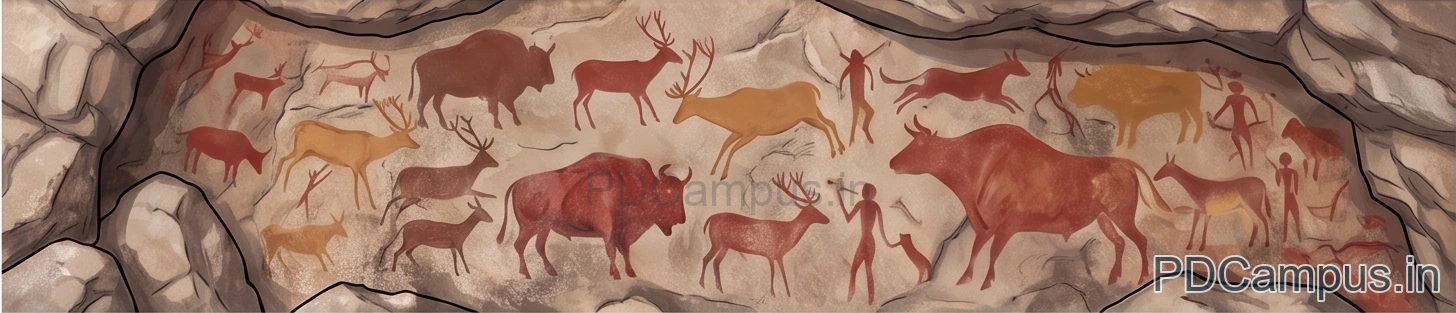
Rock art — a wall made across many generationsशैलकला: कई पीढ़ियों की बनाई दीवार
Bhimbetka’s shelters preserve paintings made in different periods, sometimes one image over another. Animals, hunting and group activities are common subjects. Some scenes have been interpreted as fishing, gathering, childbirth or burial; an interpretation of a scene is not a directly observed event from the past.भीमबेटका के आश्रयों में अलग-अलग काल के चित्र हैं; कभी एक चित्र के ऊपर दूसरा बना है। पशु, शिकार और सामूहिक गतिविधियाँ सामान्य विषय हैं। कुछ दृश्यों को मछली पकड़ने, संग्रह, जन्म या दफन के रूप में समझा गया है। किसी दृश्य की व्याख्या अतीत की घटना को सीधे देख लेने के समान नहीं है।
Rock painters used natural pigments, meaning materials that give colour. Red ochre or haematite is an important example. Charcoal, pale minerals such as limestone, and plant substances are often discussed in accounts of traditional painting materials; do not assume that this same recipe has been scientifically established for every Bhimbetka image.शैलचित्र बनाने वाले प्राकृतिक रंगद्रव्य, यानी रंग देने वाली सामग्री, इस्तेमाल करते थे। लाल गेरू या हेमेटाइट इसका महत्वपूर्ण उदाहरण है। पारंपरिक चित्रकारी के विवरणों में लकड़ी के कोयले, चूना-पत्थर जैसे हल्के रंग के खनिज और वनस्पति पदार्थों की चर्चा होती है। लेकिन यह न मानें कि भीमबेटका के हर चित्र में यही मिश्रण वैज्ञानिक रूप से सिद्ध हो चुका है।
Do not give every Bhimbetka painting one exact date. Dating rock art is difficult, and many images belong to different layers of time.भीमबेटका के सभी चित्रों को एक ही निश्चित तारीख न दें। शैलकला की तारीख तय करना कठिन है और चित्र समय की अलग-अलग परतों के हैं।
A shelter holds more than one periodएक शैलाश्रय में कई काल
Major non-Harappan Chalcolithic culturesप्रमुख गैर-हड़प्पाई ताम्रपाषाण संस्कृतियाँ
| Cultureसंस्कृति | Broad NIOS classroom chronology (not universal dates)NIOS की सामान्य शिक्षण समय-सीमा; सार्वभौमिक तारीखें नहीं | Core region and sitesमुख्य क्षेत्र और स्थल | Quick identityपहचान |
|---|---|---|---|
| Banas / Aharबनास / आहड़ | c. 2600–1900 BCEलगभग 2600–1900 ईसा-पूर्व | South-east Rajasthan: Ahar, Gilund; Balathal is another important siteदक्षिण-पूर्व राजस्थान: आहड़, गिलुंड; बालाथल भी महत्वपूर्ण | Copper use, farming villages and distinctive black-and-red pottery traditionsताँबा, खेती वाले गाँव और विशिष्ट काले-लाल बर्तन |
| Kayathaकायथा | c. 2100–2000 BCEलगभग 2100–2000 ईसा-पूर्व | Chambal region, Madhya Pradesh: Kayathaचंबल क्षेत्र, मध्य प्रदेश: कायथा | Copper objects with sharp edges, pottery and village lifeतीखी धार वाली ताँबे की वस्तुएँ, बर्तन और ग्रामीण जीवन |
| Malwaमालवा | c. 1700–1400 BCEलगभग 1700–1400 ईसा-पूर्व | Western Madhya Pradesh: Navdatoli; also Maheshwar and Eranपश्चिमी मध्य प्रदेश: नवदाटोली; महेश्वर और एरण भी | Painted pottery, mud houses, farming and storageचित्रित बर्तन, मिट्टी के घर, खेती और भंडारण |
| Jorweजोर्वे | c. 1400–700 BCEलगभग 1400–700 ईसा-पूर्व | Maharashtra: Inamgaon, Chandoli and Daimabadमहाराष्ट्र: इनामगाँव, चंदोली और दैमाबाद | Large network of villages, planned features at Inamgaon and regional potteryगाँवों का बड़ा फैलाव, इनामगाँव में नियोजित विशेषताएँ और क्षेत्रीय बर्तन |
Use the date label with the tableतालिका के साथ तारीख का संदर्भ भी याद रखें
These four ranges reproduce the broad NIOS teaching table. Excavation reports and university accounts use different ranges for some cultures and phases, particularly Ahar-Banas and Kayatha. A culture is an archaeological grouping based on recurring material features, not proof of one political state or one ethnic group. Bronze is usually a copper–tin alloy; a bronze object can occur within a settlement described broadly as Chalcolithic. Its presence does not turn every neighbouring village into the same “Bronze Age civilisation.”ये चार समय-सीमाएँ NIOS की सामान्य शिक्षण तालिका के अनुसार हैं। उत्खनन रिपोर्टों और विश्वविद्यालय की पुस्तकों में कुछ संस्कृतियों और चरणों की अलग सीमाएँ मिलती हैं, खासकर आहड़-बनास और कायथा की। पुरातात्विक संस्कृति का अर्थ बार-बार मिलने वाली समान भौतिक विशेषताओं का समूह है; इससे एक ही राज्य या जातीय समुदाय सिद्ध नहीं होता। काँसा सामान्यतः ताँबे और टिन की मिश्रधातु है। व्यापक रूप से ताम्रपाषाण कही गई बस्ती में काँसे की वस्तु भी मिल सकती है। इससे आसपास के सभी गाँव एक ही “कांस्य युगीन सभ्यता” नहीं बन जाते।
4. Site Atlas — Link Each Place with Its Evidence4. स्थल और प्रमाण: जगह के साथ तथ्य याद करें
Remember a site by linking its present-day region, its period and its evidence. A site can contain several periods. The following regional key preserves the original atlas associations; it is a study aid, not a claim that modern borders existed in prehistory.किसी स्थल को उसके आज के क्षेत्र, काल और प्रमाण से जोड़कर याद करें। एक स्थल में कई काल हो सकते हैं। अगली क्षेत्रीय सूची पुराने एटलस के संबंधों को सुरक्षित रखती है। यह पढ़ाई की सहायता है, यह दावा नहीं कि आज की सीमाएँ प्रागैतिहासिक काल में भी थीं।
- 1. Burzahom–Gufkral — Kashmir, Neolithic1. बुर्जहोम–गुफकराल — कश्मीर, नवपाषाण
- 2. Soan Valley — Palaeolithic; now in Pakistan2. सोअन घाटी — पुरापाषाण; आज पाकिस्तान में
- 3. Bagor — Rajasthan, Mesolithic3. बागोर — राजस्थान, मध्यपाषाण
- 4. Bhimbetka — Madhya Pradesh, multi-period shelters4. भीमबेटका — मध्य प्रदेश, कई काल के आश्रय
- 5. Belan Valley — Uttar Pradesh, long sequence5. बेलन घाटी — उत्तर प्रदेश, लंबा कालक्रम
- 6. Chirand — Bihar, Neolithic6. चिरांद — बिहार, नवपाषाण
- 7. Ahar–Gilund — Rajasthan, Chalcolithic7. आहड़–गिलुंड — राजस्थान, ताम्रपाषाण
- 8. Kayatha–Navdatoli — Madhya Pradesh, Chalcolithic8. कायथा–नवदाटोली — मध्य प्रदेश, ताम्रपाषाण
- 9. Chopani Mando — Uttar Pradesh, Mesolithic9. चोपनी मांडो — उत्तर प्रदेश, मध्यपाषाण
- 10. Daojali Hading — Assam, Neolithic10. दाओजली हाडिंग — असम, नवपाषाण
- 11. Langhnaj — Gujarat, Mesolithic11. लंघनाज — गुजरात, मध्यपाषाण
- 12. Inamgaon — Maharashtra, Jorwe12. इनामगाँव — महाराष्ट्र, जोर्वे
- 13. Patne — Maharashtra, Upper Palaeolithic13. पाटने — महाराष्ट्र, उच्च पुरापाषाण
- 14. Hunsgi–Isampur — Karnataka, Acheulian14. हुंसगी–इसामपुर — कर्नाटक, अश्यूलियन
- 15. Sanganakallu–Kupgal — Karnataka, Neolithic15. संगनकल्लू–कुपगल — कर्नाटक, नवपाषाण
- 16. Kurnool Caves — Andhra Pradesh, Palaeolithic16. कुर्नूल गुफाएँ — आंध्र प्रदेश, पुरापाषाण
- 17. Attirampakkam — Tamil Nadu, Palaeolithic17. अत्तिरमपक्कम — तमिलनाडु, पुरापाषाण
- 18. Paiyampalli — Tamil Nadu, Neolithic and later Iron Age18. पैयमपल्ली — तमिलनाडु, नवपाषाण और बाद का लौह युग
Palaeolithic and Mesolithic site bankपुरापाषाण और मध्यपाषाण के प्रमुख स्थल
| Site / regionस्थल / क्षेत्र | Periodकाल | What to connect with itकिस प्रमाण से जोड़ें |
|---|---|---|
| Attirampakkam, Tamil Naduअत्तिरमपक्कम, तमिलनाडु | Lower and Middle Palaeolithicनिम्न और मध्य पुरापाषाण | Long stratified Acheulian sequence; modern dating greatly extended Indian early and Middle Palaeolithic chronology.परतों में सुरक्षित लंबा अश्यूलियन क्रम; आधुनिक काल-निर्धारण ने भारतीय शुरुआती और मध्य पुरापाषाण की समय-सीमा बहुत पीछे बढ़ाई। |
| Hunsgi–Baichbal and Isampur, Karnatakaहुंसगी–बैचबल और इसामपुर, कर्नाटक | Lower Palaeolithic / Acheulianनिम्न पुरापाषाण / अश्यूलियन | Many handaxes and cleavers; Isampur is known as a quarry-cum-workshop where raw stone and tool-making activity can be studied together.बहुत-से हस्तकुठार और विदारक; इसामपुर खदान-सह-कार्यशाला है, जहाँ कच्चा पत्थर और औजार बनाने का काम साथ समझा जा सकता है। |
| Bhimbetka, Madhya Pradeshभीमबेटका, मध्य प्रदेश | Palaeolithic to later periodsपुरापाषाण से बाद के काल | Rock shelters, long occupation sequence and layered rock paintings; discovered for archaeology by V. S. Wakankar in 1957.शैलाश्रय, लंबा बसावट क्रम और कई परतों के चित्र; वी. एस. वाकणकर ने 1957 में इसका पुरातात्विक महत्व पहचाना। |
| Hathnora, Narmada Valley, Madhya Pradeshहथनौरा, नर्मदा घाटी, मध्य प्रदेश | Pleistocene / Palaeolithic contextप्लीस्टोसीन / पुरापाषाण संदर्भ | Important hominin cranial fossil; exact species classification remains debated.महत्वपूर्ण होमिनिन कपाल-जीवाश्म; ठीक प्रजाति का वर्गीकरण विवादित। |
| Belan Valley, Uttar Pradeshबेलन घाटी, उत्तर प्रदेश | Palaeolithic to Neolithic sequenceपुरापाषाण से नवपाषाण क्रम | Long occupation sequence; later sites include Chopani Mando, Koldihwa and Mahagara.लंबा बसावट क्रम; बाद के स्थलों में चोपनी मांडो, कोल्डिहवा और महगड़ा। |
| Patne, Maharashtraपाटने, महाराष्ट्र | Upper Palaeolithicउच्च पुरापाषाण | Blades and burins; ostrich-eggshell beads show ornament-making.ब्लेड और ब्यूरिन; शुतुरमुर्ग के अंडे के खोल के मनके आभूषण निर्माण बताते हैं। |
| Kurnool caves, Andhra Pradeshकुर्नूल गुफाएँ, आंध्र प्रदेश | Late/Upper Palaeolithic contextsअंतिम / उच्च पुरापाषाण संदर्भ | Cave deposits, stone and bone tools, and faunal remains.गुफाओं के जमाव, पत्थर और हड्डी के औजार तथा पशु-अवशेष। |
| Bagor, Rajasthanबागोर, राजस्थान | Mesolithicमध्यपाषाण | Microliths, animal remains and evidence useful for studying the transition toward herding.सूक्ष्मपाषाण, पशु-अवशेष और पशुपालन की ओर बदलाव समझने के प्रमाण। |
| Langhnaj, Gujaratलंघनाज, गुजरात | Mesolithicमध्यपाषाण | Microliths, human burials and animal remains.सूक्ष्मपाषाण, मानव दफन और पशु-अवशेष। |
| Sarai Nahar Rai, Mahadaha and Damdama, Uttar Pradeshसराय नाहर राय, महदहा और दमदमा, उत्तर प्रदेश | Mesolithicमध्यपाषाण | Hunter-gatherer camps and burials in the Ganga plain.गंगा के मैदान में शिकारी-संग्राहकों के पड़ाव और दफन। |
| Chopani Mando, Uttar Pradeshचोपनी मांडो, उत्तर प्रदेश | Late Palaeolithic–Mesolithic transitionअंतिम पुरापाषाण–मध्यपाषाण बदलाव | Microliths, hut floors and a sequence leading toward more settled food-collecting life.सूक्ष्मपाषाण, झोपड़ियों के फर्श और अधिक स्थिर भोजन-संग्रह जीवन की ओर बढ़ता क्रम। |
Neolithic and Chalcolithic site bankनवपाषाण और ताम्रपाषाण के प्रमुख स्थल
| Site / regionस्थल / क्षेत्र | Periodकाल | What to connect with itकिस प्रमाण से जोड़ें |
|---|---|---|
| Mehrgarh, Balochistan (Pakistan)मेहरगढ़, बलूचिस्तान, पाकिस्तान | Early Neolithic onwardशुरुआती नवपाषाण से आगे | Mud-brick houses, wheat and barley cultivation, sheep/goat herding and early village life in the north-western subcontinent.कच्ची ईंट के घर, गेहूँ-जौ की खेती, भेड़-बकरी पालन और उपमहाद्वीप के उत्तर-पश्चिम में शुरुआती ग्रामीण जीवन। |
| Burzahom and Gufkral, Kashmirबुर्जहोम और गुफकराल, कश्मीर | Neolithicनवपाषाण | Circular or rectangular pit dwellings, stone/bone tools, farming and herding.गोल या आयताकार गर्त-आवास, पत्थर-हड्डी के औजार, खेती और पशुपालन। |
| Koldihwa and Mahagara, Uttar Pradeshकोल्डिहवा और महगड़ा, उत्तर प्रदेश | Neolithicनवपाषाण | Belan valley farming settlements; rice evidence is important, while claims for extremely early dates require caution.बेलन घाटी की खेती वाली बस्तियाँ; चावल का प्रमाण महत्वपूर्ण, लेकिन बहुत शुरुआती तारीखों के दावों में सावधानी चाहिए। |
| Chirand, Biharचिरांद, बिहार | Neolithicनवपाषाण | Bone tools, polished stone objects, pottery, cereals and village remains in the middle Ganga plain.हड्डी के औजार, पॉलिश किए पत्थर, बर्तन, अनाज और मध्य गंगा मैदान में गाँव के अवशेष। |
| Daojali Hading, Assamदाओजली हाडिंग, असम | Neolithicनवपाषाण | Polished celts, distinctive pottery including cord-marked forms, and north-eastern cultural connections.पॉलिश किए सेल्ट, रस्सी की छाप वाले विशिष्ट बर्तन और उत्तर-पूर्व के सांस्कृतिक संबंध। |
| Sanganakallu–Kupgal, Karnatakaसंगनकल्लू–कुपगल, कर्नाटक | South Indian Neolithicदक्षिण भारतीय नवपाषाण | Settlement, cattle-based life, ash-mound region and specialised stone-axe production.बसावट, गोवंश के पालन पर आधारित जीवन, राख-टीलों का क्षेत्र और पत्थर की कुल्हाड़ियों का विशेषीकृत निर्माण। |
| Piklihal and Utnur, Deccanपिकलीहल और उतनूर, दक्कन | South Indian Neolithicदक्षिण भारतीय नवपाषाण | Pastoral life and ash-mound traditions linked with repeated cattle-keeping activity.पशुपालक जीवन और बार-बार पशु रखने की गतिविधियों से जुड़ी राख-टीला परंपराएँ। |
| Paiyampalli, Tamil Naduपैयमपल्ली, तमिलनाडु | Neolithic and later Iron Age sequenceनवपाषाण और बाद का लौह युग | Early farming village life, followed by later metal-using occupation; do not label every later layer simply Chalcolithic.शुरुआती खेती वाला ग्रामीण जीवन, फिर धातु इस्तेमाल करने वाली बाद की बसावट; हर बाद की परत को केवल ताम्रपाषाण न कहें। |
| Ahar, Gilund and Balathal, Rajasthanआहड़, गिलुंड और बालाथल, राजस्थान | Banas/Ahar Chalcolithicबनास / आहड़ ताम्रपाषाण | Copper use, farming villages and regional black-and-red pottery.ताँबा, खेती वाले गाँव और क्षेत्रीय काले-लाल बर्तन। |
| Navdatoli, Madhya Pradeshनवदाटोली, मध्य प्रदेश | Malwa Chalcolithicमालवा ताम्रपाषाण | Painted pottery, houses, grain and mixed farming-herding life.चित्रित बर्तन, घर, अनाज और खेती-पशुपालन वाला जीवन। |
| Inamgaon, Maharashtraइनामगाँव, महाराष्ट्र | Jorwe Chalcolithicजोर्वे ताम्रपाषाण | Large, well-studied settlement with planned features, houses, agriculture, storage and burials.बड़ी और विस्तार से अध्ययन की गई बस्ती; नियोजित विशेषताएँ, घर, खेती, भंडारण और दफन। |
| Daimabad, Maharashtraदैमाबाद, महाराष्ट्र | Chalcolithicताम्रपाषाण | Famous bronze hoard including animal figures and a wheeled chariot-like object.काँसे का प्रसिद्ध समूह, जिसमें पशु-आकृतियाँ और पहिए वाली रथ जैसी वस्तु शामिल हैं। |
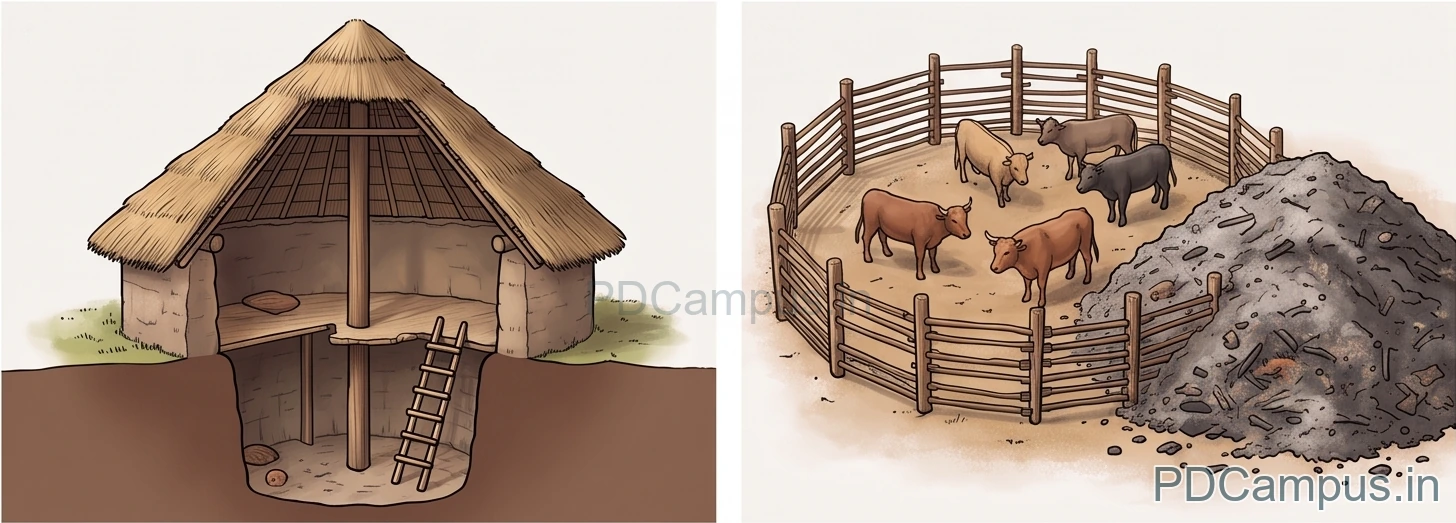
Burzahom memory pictureबुर्जहोम को चित्र से याद करें
A house partly inside the ground helps recall Burzahom’s pit dwellings in Kashmir. Cold conditions make this a useful memory connection, but a memory picture does not establish the sole reason people chose that design.जमीन के भीतर आंशिक रूप से बना घर कश्मीर के बुर्जहोम के गर्त-आवास याद दिलाता है। ठंडा परिवेश याद रखने का उपयोगी संबंध है, लेकिन इससे यह सिद्ध नहीं होता कि केवल ठंड के कारण ही यह ढाँचा चुना गया था।
Ash-mound memory pictureराख-टीले को चित्र से याद करें
Large ash deposits in parts of the southern Neolithic are linked with accumulated cattle dung and repeated burning episodes. Cattle pens and the composition of ash support this explanation. The exact purpose of every burning event, including whether it was ritual, cannot simply be assumed.दक्षिण के नवपाषाण क्षेत्रों में बड़े राख-जमाव गोवंश, यानी गाय-बैल, के जमा गोबर और बार-बार जलने की घटनाओं से जुड़े हैं। गोवंश के बाड़े और राख की संरचना इस व्याख्या को सहारा देते हैं। हर बार जलाने का ठीक उद्देश्य, जैसे कोई अनुष्ठान, अपने-आप नहीं मान लेना चाहिए।
Two sites, two forms of evidenceदो स्थल, दो तरह के प्रमाण
5. Rapid Revision — Complete Data in a Small Space5. त्वरित दोहराव: जरूरी तथ्य एक जगह
Use this section only after reading the explanations. It compresses the chapter into strong relationships, not isolated words.इसे पूरी व्याख्या पढ़ने के बाद इस्तेमाल करें। यहाँ अलग-अलग शब्दों के बजाय अध्याय के महत्वपूर्ण संबंध संक्षेप में दिए गए हैं।
Source vocabularyस्रोतों के शब्द
- Archaeology → material remainsपुरातत्त्व → भौतिक अवशेष
- Epigraphy → inscriptionsअभिलेखविद्या → अभिलेख
- Palaeography → old writing stylesपुरालिपिविद्या → पुरानी लिखावट की शैलियाँ
- Numismatics → coinsमुद्राशास्त्र → सिक्के
Time vocabularyसमय के शब्द
- c. → approximatelyc. → लगभग
- BCE → before Common EraBCE → सामान्य युग से पहले / ईसा-पूर्व
- CE → Common EraCE → सामान्य युग / ईस्वी
- BP → before 1950 CEBP → 1950 ईस्वी से पहले
- ka / Ma → thousand / million years; in an age, years agoka / Ma → हजार / दस लाख वर्ष; उम्र बताते समय इतने वर्ष पहले
Stone Age signatureपाषाण काल की पहचान
- Lower Palaeo → handaxe/cleaverनिम्न पुरापाषाण → हस्तकुठार / विदारक
- Middle Palaeo → flakes/pointsमध्य पुरापाषाण → फलक / नुकीले औजार
- Upper Palaeo → blades/burinsउच्च पुरापाषाण → ब्लेड / ब्यूरिन
- Mesolithic → microlithsमध्यपाषाण → सूक्ष्मपाषाण
- Neolithic → polished celtsनवपाषाण → पॉलिश किए सेल्ट
Food and settlementभोजन और बसावट
- Foraging → obtaining wild plant and animal foodसंग्रह-शिकार → जंगली पौधों और पशुओं से भोजन पाना
- Domestication → inherited changes in plant or animal populations through a long relationship with human management and selectionपालतूकरण → मानव प्रबंधन और चयन के लंबे संबंध से पौधों या पशुओं की पीढ़ियों में वंशानुगत बदलाव
- Pastoralism → a livelihood centred on herdsपशुपालक जीवन → झुंडों पर केंद्रित आजीविका
- Village → a settlement repeatedly or continuously occupied by a communityगाँव → समुदाय की लगातार या बार-बार बसावट
One-look period tableएक नजर में चार काल
| Periodकाल | Name meaningनाम का अर्थ | Fastest identifying clueपहचान का प्रमुख संकेत | Key life changeजीवन में मुख्य बदलाव |
|---|---|---|---|
| Palaeolithicपुरापाषाण | Old Stone Ageपुराना पाषाण युग | Chipped core/flake/blade industriesतराशे हुए क्रोड / फलक / ब्लेड परंपराएँ | Mobile hunting-gathering across a very long timeबहुत लंबे काल में घूमकर शिकार-संग्रह |
| Mesolithicमध्यपाषाण | Middle Stone Ageमध्य पाषाण युग | Microliths, often compositeसूक्ष्मपाषाण, अक्सर संयुक्त औजारों में | Broader food use, fishing, more stable camps and regional domesticationभोजन के अधिक स्रोत, मछली, अधिक स्थिर पड़ाव और क्षेत्रीय पालतूकरण |
| Neolithicनवपाषाण | New Stone Ageनया पाषाण युग | Ground and polished stone celtsघिसे-पॉलिश किए पत्थर के सेल्ट | Farming, herding, storage and villages; pottery in many phasesखेती, पशुपालन, भंडारण और गाँव; कई चरणों में बर्तन |
| Chalcolithicताम्रपाषाण | Copper-Stone Ageताँबा-पत्थर युग | Copper used beside stoneपत्थर के साथ ताँबा | Regional rural farming cultures and craft/exchange growthक्षेत्रीय ग्रामीण खेती-संस्कृतियाँ और शिल्प / आदान-प्रदान का बढ़ना |
High-density site associationsस्थल और प्रमाण के जरूरी संबंध
Palaeolithicपुरापाषाण
Attirampakkam — early Acheulian and early Middle Palaeolithic dates Hunsgi–Isampur — quarry/workshop Bhimbetka — shelters and long sequence Hathnora — Narmada hominin fossil Patne — Upper Palaeolithic and ostrich-eggshell beadsअत्तिरमपक्कम — शुरुआती अश्यूलियन और मध्य पुरापाषाण की पुरानी तारीखें। हुंसगी–इसामपुर — खदान / कार्यशाला। भीमबेटका — आश्रय और लंबा क्रम। हथनौरा — नर्मदा होमिनिन जीवाश्म। पाटने — उच्च पुरापाषाण और शुतुरमुर्ग-अंडे के खोल के मनके।
Mesolithicमध्यपाषाण
Bagor — microliths and herding transition Langhnaj — microliths and burials Sarai Nahar Rai–Mahadaha–Damdama — Ganga plain burials Chopani Mando — huts and transition Bhimbetka — prominent rock artबागोर — सूक्ष्मपाषाण और पशुपालन की ओर बदलाव। लंघनाज — सूक्ष्मपाषाण और दफन। सराय नाहर राय–महदहा–दमदमा — गंगा मैदान के दफन। चोपनी मांडो — झोपड़ियाँ और बदलाव। भीमबेटका — महत्वपूर्ण शैलकला।
Neolithic / Chalcolithicनवपाषाण / ताम्रपाषाण
Burzahom–Gufkral — pit dwellings Chirand — bone tools Daojali Hading — polished celts/cord-marked pottery Sanganakallu–Kupgal — axe production/ash-mound region Inamgaon — Jorwe settlementबुर्जहोम–गुफकराल — गर्त-आवास। चिरांद — हड्डी के औजार। दाओजली हाडिंग — पॉलिश किए सेल्ट / रस्सी की छाप वाले बर्तन। संगनकल्लू–कुपगल — कुल्हाड़ी निर्माण / राख-टीलों का क्षेत्र। इनामगाँव — जोर्वे बस्ती।
Chronology calculationsकालक्रम की गणना
Within the same eraएक ही युग के भीतर
For the same point in two years of the same era, find the difference between their year numbers. Example: from 600 BCE to 300 BCE is 600 − 300 = 300 years.एक ही युग के दो वर्षों में समान तारीख की तुलना हो तो वर्ष-संख्याओं का अंतर लें। उदाहरण: 600 ईसा-पूर्व से 300 ईसा-पूर्व तक 600 − 300 = 300 वर्ष।
Across BCE and CEईसा-पूर्व से ईस्वी के बीच
When comparing the same point in each year, let B be the BCE year number and C the CE year number. Because this historical calendar has no year zero:हर वर्ष के समान बिंदु की तुलना करते समय B को ईसा-पूर्व की वर्ष-संख्या और C को ईस्वी की वर्ष-संख्या मानें। इस ऐतिहासिक कैलेंडर में वर्ष शून्य नहीं है, इसलिए:
Elapsed years = B + C − 1बीते वर्ष = B + C − 1
Example: 2 BCE to 2 CE is 2 + 2 − 1 = 3 years. The sequence is 2 BCE → 1 BCE → 1 CE → 2 CE.उदाहरण: 2 ईसा-पूर्व से 2 ईस्वी तक 2 + 2 − 1 = 3 वर्ष। क्रम है: 2 ईसा-पूर्व → 1 ईसा-पूर्व → 1 ईस्वी → 2 ईस्वी।
Memory chain: P–M–N–Cयाद रखने की शृंखला: P–M–N–C
Pick → Mini → New food → Copperपत्थर तराशना → छोटे औजार → नया खाद्य उत्पादन → ताँबा
Palaeolithic: pick/chip stone. Mesolithic: miniature microliths. Neolithic: new food-production life. Chalcolithic: copper joins stone.P यानी पुरापाषाण: पत्थर तराशना। M यानी मध्यपाषाण: छोटे सूक्ष्मपाषाण। N यानी नवपाषाण: खाद्य उत्पादन वाला नया जीवन। C यानी ताम्रपाषाण: पत्थर के साथ ताँबा।
Evidence chain: S–C–D–Cप्रमाण की शृंखला: S–C–D–C
Source → Context → Date → Corroborateस्रोत → संदर्भ → तारीख → दूसरे प्रमाणों से मिलान
Never jump directly from a beautiful object to a confident historical story.किसी सुंदर वस्तु को देखते ही उसके बारे में पक्की ऐतिहासिक कहानी न बना लें।
Four careful facts: Stone Age dates vary by region; Attirampakkam dates are site-specific; the Hathnora fossil’s exact species label is debated; and Bhimbetka paintings belong to multiple periods rather than one single date.चार सावधान तथ्य: पाषाण काल की तारीखें क्षेत्र के अनुसार बदलती हैं; अत्तिरमपक्कम की तारीखें उसी स्थल की हैं; हथनौरा जीवाश्म की सही प्रजाति विवादित है; और भीमबेटका के चित्र अलग-अलग काल के हैं, एक ही तारीख के नहीं।
Stone continued when copper appearedताँबा आने पर भी पत्थर रहा
History is not a pile of dates. It is a careful explanation built from surviving evidence.इतिहास केवल तारीखों का ढेर नहीं है। यह बचे हुए प्रमाणों से सावधानी के साथ बनाई गई समझ है।