Buddhismबौद्ध धर्म
General Knowledge · Visual study guide with full explanationsसामान्य ज्ञान · चित्रों और पूरे विवरण के साथ अध्ययन मार्गदर्शिका
From one person's search for freedom from suffering to a many-branched Asian traditionएक व्यक्ति की दुःख से मुक्ति की खोज से एशिया में फैली अनेक शाखाओं वाली परंपरा तक
1. The Big Picture - A Path, a Community and a Living Tradition1. बड़ी तस्वीर: मार्ग, समुदाय और जीवित परंपरा
Begin with an ordinary feeling: we get something we wanted, but soon we worry about losing it or want something else. The Buddha studied this repeating uneasiness. Buddhism grew from his explanation of dukkha and a practical path for ending the craving that feeds it.एक सामान्य अनुभव से शुरुआत करें। मनचाही चीज मिलने पर भी उसके खोने की चिंता होने लगती है, या कोई दूसरी इच्छा पैदा हो जाती है। बुद्ध ने बार-बार लौटने वाली इस असंतुष्टि को समझने की कोशिश की। दुःख की उनकी व्याख्या और उसे बढ़ाने वाली तृष्णा को समाप्त करने का व्यावहारिक मार्ग बौद्ध धर्म का आधार बने।
Three Jewelsतीन रत्न
Buddha is the awakened teacher. Dhamma is the teaching and way of practice. Sangha is the community that preserves and lives it. The word may refer especially to the ordained community or, in a spiritual sense, to accomplished disciples; its meaning depends on context.बुद्ध ज्ञानप्राप्त शिक्षक हैं। धम्म उनका उपदेश और अभ्यास का मार्ग है। संघ उसे सुरक्षित रखने और जीने वाला समुदाय है। संदर्भ के अनुसार संघ का अर्थ विशेष रूप से दीक्षित भिक्षु-भिक्षुणियों का समुदाय या आध्यात्मिक उपलब्धि प्राप्त शिष्य भी हो सकता है।
Not only a beliefकेवल मान्यता नहीं
The path joins understanding, ethical conduct and training of the mind. It asks a learner to observe cause and effect in experience.यह मार्ग समझ, नैतिक आचरण और मन के प्रशिक्षण को जोड़ता है। विद्यार्थी अपने अनुभव में कारण और परिणाम को देखने का अभ्यास करता है।
A changing traditionबदलती हुई परंपरा
Buddhism did not remain one uniform block. Monastic lineages, philosophical schools, new texts, rituals and local cultures developed over many centuries.बौद्ध धर्म एक ही समान रूप में नहीं रहा। कई शताब्दियों में मठीय वंश-परंपराएँ, दार्शनिक मत, नए ग्रंथ, अनुष्ठान और स्थानीय सांस्कृतिक रूप विकसित हुए।
Date honesty: textbooks often give c. 563–483 BCE or nearby dates. Buddhist traditions preserve other chronologies, and modern scholarship often places the Buddha broadly in the 5th century BCE. Remember the life sequence securely; treat an exact birth or death year as tradition-dependent unless a question names a convention.तारीखों में सावधानी: पाठ्यपुस्तकें अक्सर लगभग 563–483 ईसा-पूर्व या आसपास की तारीखें देती हैं। बौद्ध परंपराओं में दूसरे कालक्रम भी हैं और आधुनिक शोध बुद्ध को प्रायः व्यापक रूप से पाँचवीं शताब्दी ईसा-पूर्व में रखता है। जीवन की घटनाओं का क्रम अच्छी तरह याद करें। निश्चित जन्म या मृत्यु-वर्ष को परंपरा पर आधारित मानें, जब तक प्रश्न किसी खास कालक्रम का नाम न बताए।
Why these questions mattered in the Ganga plainगंगा के मैदान में ये सवाल क्यों महत्वपूर्ण हुए
Buddhism developed among the renunciant or shramana movements of northern India, alongside Jain and other traditions. Growing towns, trade, larger states and changing social relationships provided a setting for debate about action, rebirth and liberation. Buddhist teaching did not make Vedic ritual or birth in a high social group the necessary route to liberation. This is a historical setting, not a claim that one economic change mechanically caused a religion.उत्तर भारत के श्रमण या संन्यासी आंदोलनों में जैन तथा अन्य परंपराओं के साथ बौद्ध धर्म विकसित हुआ। बढ़ते नगर, व्यापार, बड़े राज्य और बदलते सामाजिक संबंध कर्म, पुनर्जन्म और मुक्ति पर बहस की पृष्ठभूमि बने। बौद्ध शिक्षा ने वैदिक कर्मकांड या ऊँचे सामाजिक वर्ग में जन्म को मुक्ति का अनिवार्य मार्ग नहीं माना। यह ऐतिहासिक परिवेश है; किसी एक आर्थिक बदलाव से धर्म अपने-आप बन जाने का दावा नहीं।
2. Learn from Zero - The Life Story and the Core Teaching2. शुरुआत से समझें: जीवन-कथा और मुख्य शिक्षाएँ
Buddha is a title meaning “Awakened One.” Tradition names him Siddhartha Gautama, associated with the Shakya community near Kapilavastu. The story matters because each stage—comfort, questioning, extremes and balance—leads into a teaching. Biographical details preserved in Buddhist literature are not all contemporary eyewitness records.बुद्ध का अर्थ जागृत या ज्ञानप्राप्त व्यक्ति है; यह उपाधि है। परंपरा उनका नाम सिद्धार्थ गौतम बताती है और उन्हें कपिलवस्तु के पास शाक्य समुदाय से जोड़ती है। जीवन-कथा में सुख-सुविधा, सवाल, अति और संतुलन के चरण शिक्षाओं से जुड़ते हैं। बौद्ध साहित्य में सुरक्षित सभी जीवन-विवरण उसी समय के प्रत्यक्षदर्शियों के अभिलेख नहीं हैं।
- Lumbini: born to Maya; after her death, raised by Mahaprajapati Gautami in the traditional biography.लुंबिनी: परंपरागत जीवन-कथा में माता माया; उनकी मृत्यु के बाद महाप्रजापती गौतमी ने पालन किया।
- Kapilavastu: Shakya upbringing; Yashodhara and Rahula belong to the traditional family story.कपिलवस्तु: शाक्य परिवेश में बचपन; यशोधरा और राहुल परंपरागत परिवार-कथा के भाग हैं।
- Great Departure: leaves household life and learns from teachers and ascetics.महाभिनिष्क्रमण: गृहस्थ जीवन छोड़कर शिक्षकों और तपस्वियों से सीखना।
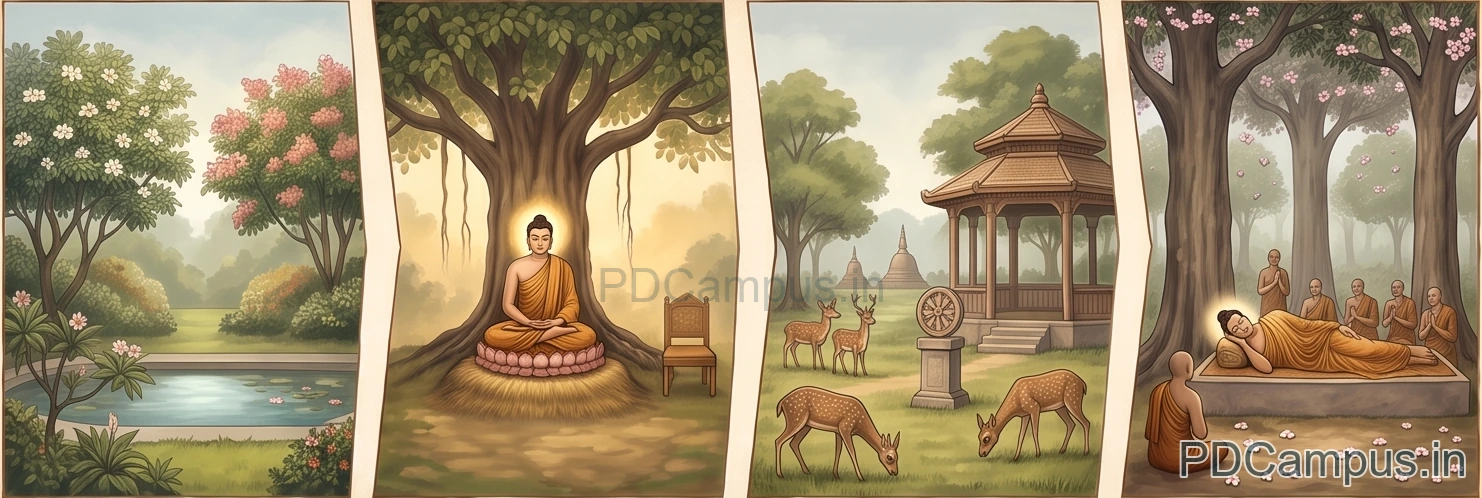
- Bodh Gaya: abandons extremes and awakens beneath the Bodhi tree.बोधगया: अतियों को छोड़कर बोधिवृक्ष के नीचे जागृति।
- Sarnath to Kushinagar: teaches for decades; traditional accounts give a final age of about eighty.सारनाथ से कुशीनगर: कई दशकों तक उपदेश; परंपरागत विवरण अंतिम उम्र लगभग अस्सी वर्ष बताते हैं।
| Siteस्थल | Associated eventसंबद्ध घटना | Present locationवर्तमान स्थान |
|---|---|---|
| Lumbiniलुंबिनी | Birth in Buddhist traditionबौद्ध परंपरा में जन्म | Terai, Nepalतराई, नेपाल |
| Bodh Gayaबोधगया | Awakeningज्ञानप्राप्ति | Bihar, Indiaबिहार, भारत |
| Sarnathसारनाथ | First teachingप्रथम उपदेश | Uttar Pradesh, Indiaउत्तर प्रदेश, भारत |
| Kushinagarकुशीनगर | Parinirvanaमहापरिनिर्वाण | Uttar Pradesh, Indiaउत्तर प्रदेश, भारत |
The early Buddhist account of the search names Alara Kalama and Uddaka Ramaputta. Gautama learned meditative disciplines in these circles before seeking awakening beyond those attainments. These names belong to the textual life account, not to independently dated eyewitness records.खोज के शुरुआती बौद्ध विवरण में आलार कालाम और उद्दक रामपुत्त के नाम आते हैं। गौतम ने इन साधना-समूहों में ध्यान की विधियाँ सीखीं और फिर उन उपलब्धियों से आगे ज्ञानप्राप्ति की खोज की। ये नाम ग्रंथों में वर्णित जीवनकथा के हैं; स्वतंत्र रूप से तिथि-निर्धारित प्रत्यक्षदर्शी अभिलेखों के नहीं।
The Four Sightsचार दृश्य
Traditional biographies say Siddhartha saw an old person, a sick person, a corpse and a calm renunciant. They turned hidden human facts into one question: can suffering be understood and overcome?परंपरागत जीवनियाँ कहती हैं कि सिद्धार्थ ने वृद्ध, रोगी, मृत व्यक्ति और शांत संन्यासी को देखा। इन दृश्यों ने जीवन के तथ्यों को एक सवाल में बदला: क्या दुःख को समझकर उससे मुक्त हुआ जा सकता है?
Why extremes failedदोनों अतियाँ क्यों असफल रहीं
Palace pleasure did not give lasting peace. Severe self-starvation weakened the body but did not create wisdom. This discovery leads to the Middle Way.महल की सुख-सुविधा से स्थायी शांति नहीं मिली। अत्यधिक उपवास ने शरीर कमजोर किया, लेकिन प्रज्ञा नहीं दी। इसी अनुभव से मध्यम मार्ग की बात जुड़ती है।
First sermonपहला उपदेश
At the Deer Park near Sarnath he taught five former companions. This is remembered as Dharmachakra-pravartana - setting the wheel of Dhamma in motion.सारनाथ के पास मृगदाव में उन्होंने अपने पाँच पुराने साथियों को उपदेश दिया। इसे धर्मचक्र-प्रवर्तन, यानी धम्म के चक्र को चलाना, कहा जाता है।
Four places, four different eventsचार स्थान, चार अलग घटनाएँ
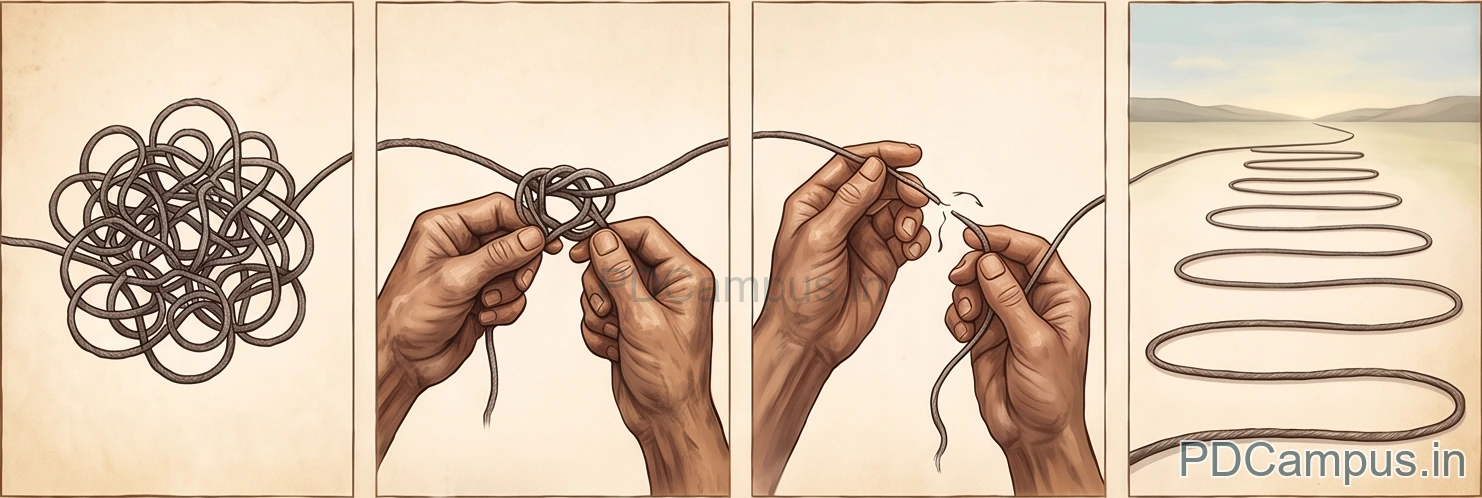
Four Noble Truths - like a doctor's methodचार आर्य सत्य: चिकित्सक की विधि जैसा संबंध
Understand the diagnosis in ordinary languageसमस्या को सामान्य भाषा में समझें
- Dukkha: conditioned life is unstable and cannot give permanent satisfaction.दुःख: परिस्थितियों पर निर्भर जीवन बदलता रहता है और स्थायी संतुष्टि नहीं देता।
- Samudaya: craving, grasping and ignorance feed dukkha.समुदय: तृष्णा, पकड़ और अज्ञान दुःख को बढ़ाते हैं।
- Nirodha: when that fuel ceases, release is possible.निरोध: यह ईंधन समाप्त होने पर मुक्ति संभव है।
- Magga: the Noble Eightfold Path trains us toward that release.मार्ग: आर्य अष्टांगिक मार्ग इस मुक्ति की ओर प्रशिक्षण देता है।
Important: the first truth does not say every second is pain. It says whatever changes cannot be held as a permanent source of satisfaction.पहला सत्य यह नहीं कहता कि हर पल केवल दर्द है। बात यह है कि बदलने वाली वस्तु को स्थायी संतुष्टि का आधार बनाकर पकड़ा नहीं जा सकता।
The doctor comparison is a memory aid: recognise a problem, identify what sustains it, understand that ending it is possible, and follow a treatment. Here the problem is dukkha and the practice is the Buddhist path. This is an analogy for organising the teaching, not a medical claim or a claim that every wish is harmful. A constructive intention to learn differs from compulsive craving.चिकित्सक की तुलना याद रखने की सहायता है: समस्या पहचानना, उसे बनाए रखने वाले कारण समझना, उसके समाप्त होने की संभावना जानना और उपाय अपनाना। यहाँ समस्या दुःख और अभ्यास बौद्ध मार्ग है। यह शिक्षा को व्यवस्थित करने की उपमा है, चिकित्सा संबंधी दावा या हर इच्छा को हानिकारक बताने की बात नहीं। सीखने का उपयोगी संकल्प और बाध्य करने वाली तृष्णा अलग हैं।
Understand the problem and the pathसमस्या और मार्ग समझें
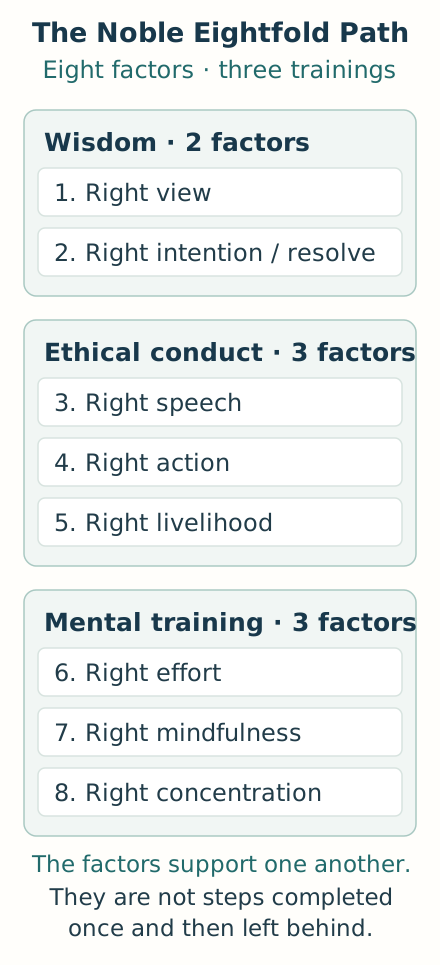
The Noble Eightfold Path - eight parts, three trainingsआर्य अष्टांगिक मार्ग: आठ अंग, तीन प्रशिक्षण
Do not read “right” as merely “correct answer.” It means a way aligned with freedom from greed, hatred and confusion. The eight factors support one another; they are not eight stairs completed once and forgotten.सम्यक का अर्थ केवल परीक्षा का सही उत्तर नहीं है। यह लोभ, द्वेष और भ्रम से मुक्ति की दिशा में चलने वाला तरीका है। आठों अंग एक-दूसरे की सहायता करते हैं; ये एक बार चढ़कर भूल जाने वाली आठ सीढ़ियाँ नहीं हैं।
| Factorअंग | What to learnक्या सीखें | Trainingप्रशिक्षण |
|---|---|---|
| 1. Right view1. सम्यक दृष्टि | Understand dukkha, its conditions, cessation and the path; notice the consequences of action.दुःख, उसकी परिस्थितियाँ, निरोध और मार्ग समझें; काम के परिणाम देखें। | Wisdom / prajnaप्रज्ञा |
| 2. Right intention or resolve2. सम्यक संकल्प | Develop renunciation, goodwill and non-harming instead of grasping and hostility.पकड़ और शत्रुता की जगह त्याग, सद्भाव और अहिंसा का संकल्प विकसित करें। | Wisdom / prajnaप्रज्ञा |
| 3. Right speech3. सम्यक वाणी | Avoid lies, speech that divides people, abuse and empty chatter.झूठ, लोगों को बाँटने वाली बात, अपमान और व्यर्थ बकवास से बचें। | Ethical conduct / shilaशील |
| 4. Right action4. सम्यक कर्मांत | Avoid killing, taking what is not given and sexual misconduct.हत्या, बिना दिए लेना और यौन दुराचार छोड़ें। | Ethical conduct / shilaशील |
| 5. Right livelihood5. सम्यक आजीविका | Earn a living without dishonest or harmful conduct.बेईमानी और हानिकारक आचरण से बचकर जीविका कमाएँ। | Ethical conduct / shilaशील |
| 6. Right effort6. सम्यक व्यायाम | Prevent and abandon unwholesome states; develop and sustain wholesome ones.अकुशल अवस्थाओं को रोकें और छोड़ें; कुशल अवस्थाएँ पैदा करें और बनाए रखें। | Mental training / samadhiमानसिक प्रशिक्षण / समाधि |
| 7. Right mindfulness7. सम्यक स्मृति | Maintain attentive awareness of body, feelings, mind and the patterns being experienced.शरीर, अनुभूतियों, मन और अनुभव में चल रहे ढाँचों के प्रति सजग ध्यान रखें। | Mental training / samadhiमानसिक प्रशिक्षण / समाधि |
| 8. Right concentration8. सम्यक समाधि | Develop steady collectedness of mind; early texts explain it through four jhanas, or stages of meditative absorption.मन की स्थिर एकाग्रता विकसित करें; शुरुआती ग्रंथ इसे चार झान, यानी गहरी ध्यान-अवस्थाओं से समझाते हैं। | Mental training / samadhiमानसिक प्रशिक्षण / समाधि |
For example, an insulting message may provoke anger. Understanding the reaction connects with view; deciding not to retaliate connects with intention; avoiding a cruel reply connects with speech. Effort and mindfulness help sustain that choice. This small example illustrates cooperation among factors; it does not claim that one polite reply completes the path. Samadhi can name both the broad mental-training group and, more narrowly, the eighth factor of concentration.उदाहरण के लिए अपमानजनक संदेश पर क्रोध आ सकता है। प्रतिक्रिया को समझना दृष्टि से, बदला न लेने का निश्चय संकल्प से और कठोर उत्तर न देना वाणी से जुड़ता है। प्रयास और सजगता उस चुनाव को बनाए रखने में मदद करते हैं। इससे अंगों का सहयोग समझ आता है; एक विनम्र उत्तर से पूरा मार्ग सिद्ध नहीं हो जाता। समाधि शब्द मानसिक प्रशिक्षण के बड़े समूह और अधिक संकुचित अर्थ में आठवें एकाग्रता-अंग, दोनों के लिए आ सकता है।
Eight factors within three trainingsतीन प्रशिक्षणों में आठ अंग

3. Complete Knowledge and Data Bank - Ideas, Community, Councils, Schools and Texts3. पूरा ज्ञान-भंडार: विचार, समुदाय, संगीतियाँ, परंपराएँ और ग्रंथ
Now we fill the full shelf. First come the ideas that explain experience. Next comes the community that carried them. Then councils, schools and books show how a spoken teaching became many preserved traditions.पहले अनुभव को समझाने वाले विचार पढ़ें। फिर उन्हें आगे ले जाने वाला समुदाय समझें। संगीतियों, मतों और पुस्तकों से पता चलता है कि मौखिक शिक्षा किस तरह कई सुरक्षित परंपराओं में विकसित हुई।
Three Marksअस्तित्व के तीन लक्षण
- Anicca: conditioned things change.अनिच्च: परिस्थितियों से बनी वस्तुएँ बदलती हैं।
- Dukkha: what changes cannot permanently satisfy grasping.दुःख: बदलने वाली वस्तु को पकड़ने से स्थायी संतुष्टि नहीं मिलती।
- Anatta: no unchanging, independent self can be found.अनत्ता: कोई अपरिवर्तनीय और स्वतंत्र आत्मा नहीं मिलती।
Five aggregates: analyse the changing personपाँच स्कंध: बदलते व्यक्ति को समझें
- Rupa: bodily or material form.रूप: शरीर या भौतिक रूप।
- Vedana: pleasant, unpleasant or neutral feeling-tone.वेदना: सुखद, दुःखद या तटस्थ अनुभूति।
- Sanna / samjna: perception and recognition.संज्ञा: पहचान और बोध।
- Sankhara / samskara: volitional formations and related mental activities.संस्कार: संकल्प से बनने वाली प्रवृत्तियाँ और संबंधित मानसिक गतिविधियाँ।
- Vinnana / vijnana: consciousness connected with experience.विज्ञान: अनुभव से जुड़ी चेतना।
The five aggregates are an analytical grouping in Buddhist teaching. Anatta asks the practitioner not to treat these changing processes as a permanent, controllable self. It does not mean that ordinary persons, ethical responsibility or the consequences of actions can simply be ignored. Likewise, anicca concerns conditioned things; do not turn it into the careless claim that Buddhism treats nirvana as just another changing object.पाँच स्कंध बौद्ध शिक्षा में विश्लेषण का समूह हैं। अनत्ता का अभ्यास इन बदलती प्रक्रियाओं को स्थायी, पूरी तरह नियंत्रित आत्मा न मानने को कहता है। इसका अर्थ साधारण व्यक्ति, नैतिक जिम्मेदारी या कर्म के परिणामों की अनदेखी करना नहीं है। इसी तरह अनिच्च परिस्थितियों से बनी वस्तुओं से जुड़ा है; इससे यह लापरवाह निष्कर्ष न निकालें कि बौद्ध धर्म निर्वाण को भी केवल बदलती वस्तु मानता है।
Karma and rebirthकर्म और पुनर्जन्म
In Buddhist teaching, karma centres on intentional action and its effects. Rebirth describes conditioned continuity without an eternal soul: one process helps give rise to another, like one flame lighting another. The flame is an analogy, not physical proof of rebirth. Karma is not a claim that every hardship is deserved or that present choices do not matter.बौद्ध शिक्षा में कर्म का केंद्र इरादे से किया गया काम और उसके परिणाम हैं। पुनर्जन्म स्थायी आत्मा के बिना परिस्थितियों से चलने वाली निरंतरता बताता है: एक प्रक्रिया दूसरी के बनने में सहायक होती है, जैसे एक लौ से दूसरी लौ जलना। लौ केवल उपमा है, पुनर्जन्म का भौतिक प्रमाण नहीं। कर्म का अर्थ यह नहीं कि हर कठिनाई योग्य दंड है या वर्तमान में किए गए चुनाव महत्वहीन हैं।
Nirvanaनिर्वाण
Nirvana is the ending of greed, hatred and delusion - the extinguishing of the fuel that keeps dukkha and rebirth going. It is not simply a pleasant heaven.निर्वाण लोभ, द्वेष और मोह का समाप्त होना है—उस ईंधन का बुझना जिससे दुःख और पुनर्जन्म का चक्र चलता है। इसे केवल सुखद स्वर्ग न समझें।
Dependent Origination: how conditions sustain sufferingप्रतीत्यसमुत्पाद: परिस्थितियों से दुःख कैसे बना रहता है
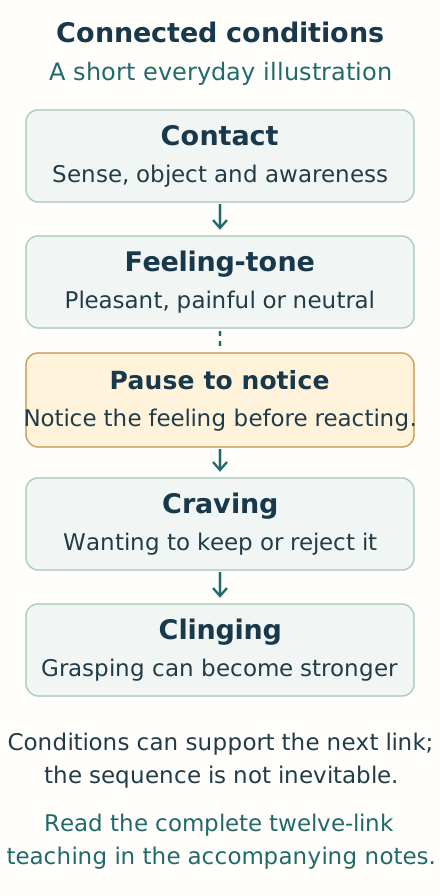
Pratityasamutpada (Pali: paticcasamuppada) means dependent arising: events occur when supporting conditions are present. The twelve-link form explains the round of rebirth in Buddhist teaching. One shorter relationship can also be studied in experience: contact brings feeling; feeling can feed craving; craving can become clinging. Mindful attention can help a practitioner notice the response. This everyday example is not a substitute for the full traditional account.प्रतीत्यसमुत्पाद, पालि में पटिच्चसमुप्पाद, का अर्थ परिस्थितियों पर निर्भर उत्पत्ति है। सहायक परिस्थितियाँ होने पर घटनाएँ घटती हैं। बौद्ध शिक्षा में बारह कड़ियों वाला रूप पुनर्जन्म के चक्र को समझाता है। अनुभव में एक छोटा संबंध भी देखा जा सकता है: संपर्क से अनुभूति होती है; उससे तृष्णा और फिर पकड़ बन सकती है। सजग ध्यान से साधक अपनी प्रतिक्रिया पहचान सकता है। यह रोजमर्रा का उदाहरण पूरी परंपरागत व्याख्या का विकल्प नहीं है।
Twelve links: keep the full sequenceबारह कड़ियाँ: पूरा क्रम समझें
- 1. Ignorance (avidya): not understanding the truths.1. अविद्या: सत्यों को न समझना।
- 2. Formations (samskara): conditioned volitional activities.2. संस्कार: परिस्थितियों से जुड़ी संकल्पात्मक गतिविधियाँ।
- 3. Consciousness (vijnana).3. विज्ञान: चेतना।
- 4. Name-and-form (nama-rupa): mental and bodily processes.4. नाम-रूप: मानसिक और शारीरिक प्रक्रियाएँ।
- 5. Six sense bases (shadayatana): the five senses and mind.5. षडायतन: पाँच इंद्रियाँ और मन।
- 6. Contact (sparsha).6. स्पर्श: संपर्क।
- 7. Feeling (vedana): pleasant, unpleasant or neutral tone.7. वेदना: सुखद, दुःखद या तटस्थ अनुभूति।
- 8. Craving (trishna).8. तृष्णा।
- 9. Clinging (upadana).9. उपादान: पकड़।
- 10. Becoming (bhava).10. भव: अस्तित्व में आने की प्रक्रिया।
- 11. Birth (jati).11. जाति: जन्म।
- 12. Ageing-and-death (jara-marana), with the associated distress.12. जरा-मरण: बुढ़ापा और मृत्यु तथा उनसे जुड़ा दुःख।
Read the arrows as conditional relationships, not twelve material objects or a permanent soul travelling between boxes. Here jati means birth, not the social category called caste. Vedana means feeling-tone, not only pain. The traditional teaching also describes cessation: when the sustaining conditions cease, their dependent results cease. Traditions interpret the time-span and detailed operation of the sequence in more than one way.तीरों को परिस्थितियों के संबंध की तरह पढ़ें, बारह भौतिक वस्तुओं या खानों में घूमती स्थायी आत्मा की तरह नहीं। यहाँ जाति का अर्थ जन्म है, सामाजिक जाति-वर्ग नहीं। वेदना केवल दर्द नहीं, अनुभूति का सुखद, दुःखद या तटस्थ स्वरूप है। परंपरा निरोध का क्रम भी बताती है: सहायक परिस्थितियाँ समाप्त होने पर उन पर निर्भर परिणाम समाप्त होते हैं। क्रम के समय-विस्तार और काम करने के विवरण की एक से अधिक व्याख्याएँ हैं।
A condition is not a travelling soulपरिस्थिति का संबंध, घूमती आत्मा नहीं
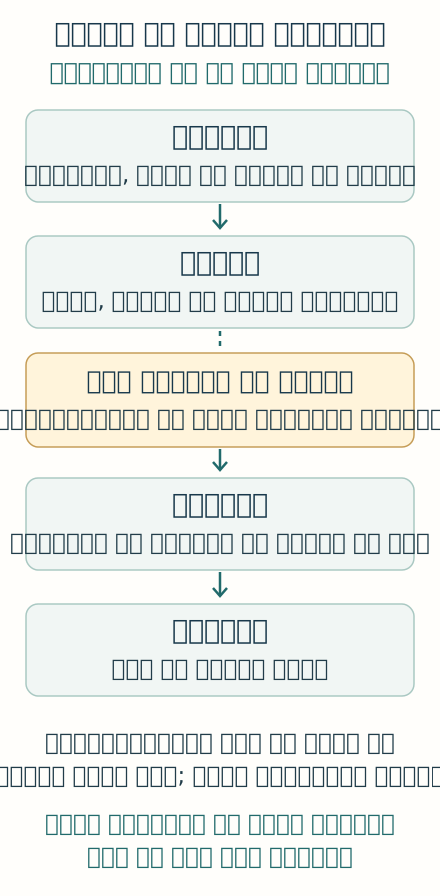
Five Precepts for lay followersगृहस्थ अनुयायियों के पाँच शील
- Refrain from taking life.प्राण लेने से बचना।
- Refrain from taking what is not given.जो दिया नहीं गया, उसे लेने से बचना।
- Refrain from sexual misconduct.यौन दुराचार से बचना।
- Refrain from false speech; the wider training in right speech also addresses divisive, abusive and idle speech.झूठ बोलने से बचना; सम्यक वाणी के व्यापक अभ्यास में फूट डालने वाली, अपमानजनक और व्यर्थ बातों से बचना भी शामिल है।
- Refrain from intoxicants that cloud awareness.सजगता को धुँधला करने वाले नशीले पदार्थों से बचना।
Four kinds of followerचार प्रकार के अनुयायी
- Bhikkhu: ordained monk.भिक्खु या भिक्षु: दीक्षित पुरुष संन्यासी।
- Bhikkhuni: ordained nun.भिक्खुनी या भिक्षुणी: दीक्षित महिला संन्यासिनी।
- Upasaka: male lay follower.उपासक: पुरुष गृहस्थ अनुयायी।
- Upasika: female lay follower.उपासिका: महिला गृहस्थ अनुयायी।
Vinaya gives monastic discipline. Lay people offer dana or generosity; monastics teach and model the path.विनय मठीय अनुशासन बताता है। गृहस्थ दान और उदारता से सहायता करते हैं; भिक्षु-भिक्षुणियाँ शिक्षा देते और मार्ग के अभ्यास का उदाहरण प्रस्तुत करते हैं।
Lay support included food, robes and care for monastics. Monastic routines included study, teaching and communal discipline. In the Pali Vinaya tradition, vassa is the rains retreat; uposatha gatherings include recitation of the Patimokkha discipline and acknowledgement of relevant offences. Practices and calendars differ among Buddhist communities.गृहस्थ भिक्षु-भिक्षुणियों को भोजन, चीवर और देखभाल का सहयोग देते थे। मठवासी जीवन में अध्ययन, शिक्षा और सामूहिक अनुशासन शामिल थे। पालि विनय परंपरा में वस्स वर्षावास है; उपोसथ सभाओं में पातिमोक्ख अनुशासन का पाठ और संबंधित अपराधों की स्वीकारोक्ति होती है। अलग बौद्ध समुदायों में व्यवहार और पंचांग भिन्न हो सकते हैं।
Equality with a limit: the Sangha admitted people from different social backgrounds and eventually formed an order of nuns. That challenged important boundaries. Yet the surviving Vinaya also gives monks and nuns different rules. Do not turn a complex ancient institution into either a perfect modern equality story or a closed caste order.समानता और उसकी सीमा: संघ में अलग-अलग सामाजिक पृष्ठभूमियों के लोग आए और बाद में भिक्षुणी संघ भी बना। इससे महत्वपूर्ण सीमाओं को चुनौती मिली। लेकिन सुरक्षित विनय में भिक्षु और भिक्षुणियों के लिए अलग नियम भी हैं। इस जटिल प्राचीन संस्था को न तो पूर्ण आधुनिक समानता और न ही केवल बंद जाति-व्यवस्था की कहानी बनाएँ।
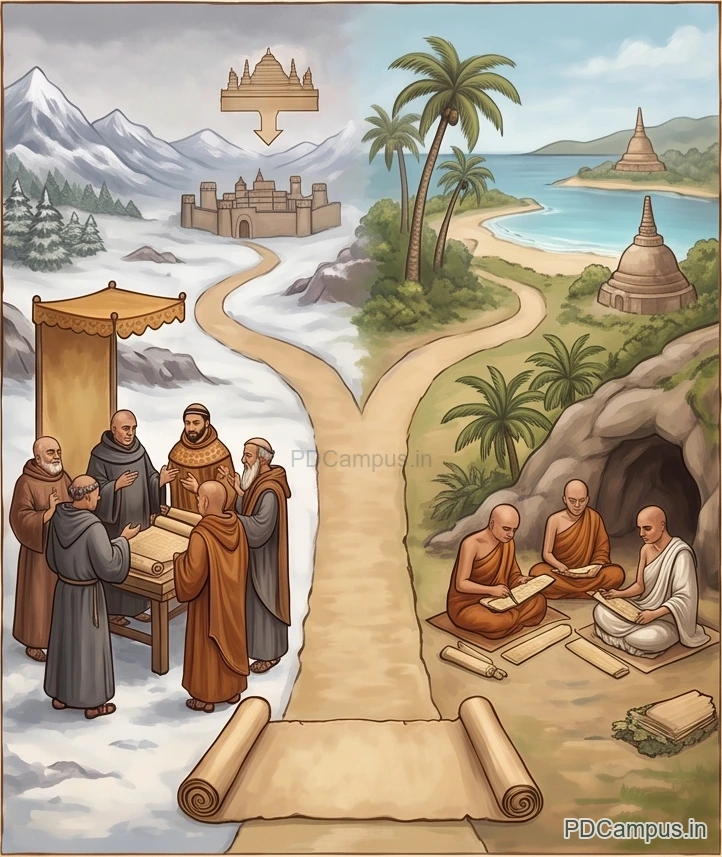
The Buddhist councils - a tradition-aware railबौद्ध संगीतियाँ: परंपराओं का संदर्भ साथ रखें
1. Rajagriha1. राजगृह
Tradition: soon after the Buddha's passing, under Ajatashatru's patronage. Mahakassapa presides; Ananda recites teachings and Upali recites discipline. Aim: preserve Dhamma and Vinaya.परंपरा के अनुसार बुद्ध के अंतिम निर्वाण के शीघ्र बाद अजातशत्रु के संरक्षण में सभा हुई। महाकस्सप ने अध्यक्षता की; आनंद ने उपदेश और उपालि ने अनुशासन सुनाया। उद्देश्य धम्म और विनय को सुरक्षित रखना था।
2. Vaishali2. वैशाली
Tradition places a second council at Vaishali about one century after the Buddha’s passing and links it with Kalashoka. It discusses ten disputed monastic practices. Later accounts connect this period with the Sthavira–Mahasanghika division, but its timing and causes differ across traditions; do not treat the council and the first schism as one securely documented event.परंपरा बुद्ध के अंतिम निर्वाण के लगभग एक शताब्दी बाद वैशाली में दूसरी संगीति रखती है और उसे कालाशोक से जोड़ती है। इसमें दस विवादित मठीय आचरणों की चर्चा हुई। बाद के विवरण इस दौर को स्थविर–महासांघिक विभाजन से जोड़ते हैं, लेकिन उसके समय और कारण अलग परंपराओं में अलग हैं। संगीति और पहले संघ-विभाजन को एक ही निश्चित रूप से प्रमाणित घटना न मानें।
3. Pataliputra3. पाटलिपुत्र
Theravada tradition: under Ashoka, led by Moggaliputta Tissa. It associates doctrinal clarification, purification of the Sangha and missions with this council.थेरवाद परंपरा इसे अशोक के समय मोग्गलिपुत्त तिस्स के नेतृत्व में रखती है। इसी सभा से सिद्धांतों की स्पष्टता, संघ की शुद्धि और धर्म-प्रचार यात्राएँ जोड़ी जाती हैं।
4. Two traditions4. दो परंपराएँ
Two traditions use the label Fourth Council. Northern accounts associate a council at Kundalavana in Kashmir with Kanishka, Vasumitra and Sarvastivada commentary. Theravada accounts associate Aluvihara in Sri Lanka with writing down the Pali canon, traditionally in the 1st century BCE. They are not two accounts of a single universally recognised meeting.चौथी संगीति का नाम दो परंपराएँ इस्तेमाल करती हैं। उत्तरी विवरण कश्मीर के कुंडलवन की सभा को कनिष्क, वसुमित्र और सर्वास्तिवाद की व्याख्याओं से जोड़ते हैं। थेरवाद के विवरण श्रीलंका के आलुविहार में पालि ग्रंथों को लिखे जाने को परंपरागत रूप से पहली शताब्दी ईसा-पूर्व में रखते हैं। ये एक ही सर्वमान्य सभा के दो विवरण नहीं हैं।
Most important correction: council accounts were written within different Buddhist traditions and do not agree in every detail. Mahayana did not simply appear at one fourth council, and Hinayana is a polemical label meaning “lesser vehicle.” Use Theravada when naming the living tradition.सबसे जरूरी सुधार: संगीतियों की कथाएँ अलग बौद्ध परंपराओं में लिखी गईं और हर बात पर सहमत नहीं हैं। महायान किसी एक चौथी संगीति में अचानक नहीं बना। हीनयान का अर्थ छोटा या निम्न वाहन है और यह विरोध में इस्तेमाल हुआ नाम है। जीवित परंपरा का नाम बताते समय थेरवाद कहें।
One council number, different traditionsएक संगीति संख्या, अलग परंपराएँ
Schools and major traditionsमत और प्रमुख परंपराएँ
| Traditionपरंपरा | Main learning emphasisमुख्य बल | Texts and broad regionsग्रंथ और व्यापक क्षेत्र | Careful factसावधान तथ्य |
|---|---|---|---|
| Early schoolsप्रारंभिक मत | Different interpretations of discipline and doctrine; Sthavira, Mahasanghika, Sarvastivada and others.अनुशासन और सिद्धांत की अलग व्याख्याएँ; स्थविर, महासांघिक, सर्वास्तिवाद और अन्य। | Canons survive fully or partly in Pali, Sanskrit fragments, Chinese and Tibetan translations.पालि, संस्कृत के अंशों और चीनी-तिब्बती अनुवादों में पूरे या आंशिक ग्रंथ बचे हैं। | There were many early schools, not just two.शुरुआती मत अनेक थे, केवल दो नहीं। |
| Theravadaथेरवाद | “Teaching of the Elders”; monastic discipline, meditation, wisdom and arhat ideal.स्थविरों की शिक्षा; मठीय अनुशासन, ध्यान, प्रज्ञा और अर्हत का आदर्श। | Pali Tipitaka; Sri Lanka, Myanmar, Thailand, Laos and Cambodia.पालि तिपिटक; श्रीलंका, म्यांमार, थाईलैंड, लाओस और कंबोडिया। | Theravada is not identical to every school once insultingly called “Hinayana.”थेरवाद उन सभी मतों का समान नाम नहीं है जिन्हें कभी विरोध में हीनयान कहा गया। |
| Mahayanaमहायान | Bodhisattva ideal, compassion and wisdom; many philosophical and devotional movements.बोधिसत्त्व का आदर्श, करुणा और प्रज्ञा; कई दार्शनिक और भक्तिपरक आंदोलन। | Prajnaparamita, Lotus and Pure Land sutras; China, Korea, Japan, Vietnam and beyond.प्रज्ञापारमिता, लोटस और शुद्धभूमि सूत्र; चीन, कोरिया, जापान, वियतनाम और अन्य क्षेत्र। | “Great Vehicle” is a broad family, not one centrally governed sect.महान वाहन एक व्यापक परिवार है, एक केंद्रीय शासन वाला अकेला संप्रदाय नहीं। |
| Vajrayanaवज्रयान | Esoteric or tantric practices guided by a teacher; mantra, mudra, mandala and deity yoga.गुरु के मार्गदर्शन में गूढ़ या तांत्रिक अभ्यास; मंत्र, मुद्रा, मंडल और देवता-योग। | Tantras; Tibet, Himalayan regions and Mongolia, with historical Indian centres.तंत्र; तिब्बत, हिमालयी क्षेत्र और मंगोलिया; भारत में ऐतिहासिक केंद्र। | It grew strongly from about the mid-first millennium CE, not in the Buddha's lifetime.इसका मजबूत विकास लगभग पहली सहस्राब्दी ईस्वी के मध्य से हुआ, बुद्ध के जीवनकाल में नहीं। |
Arhat, bodhisattva and Buddha are not synonymsअर्हत, बोधिसत्त्व और बुद्ध एक ही शब्द नहीं
An arhat is a liberated disciple who has ended the defilements. A bodhisattva is a being oriented toward Buddhahood; Mahayana gives this ideal an especially wide role in working for the awakening of beings. The term also appears in accounts of the Buddha before his awakening. A Buddha is awakened and teaches the path. These differences do not mean Theravada lacks compassion or Mahayana lacks discipline. Mahayana developed within a world of existing monastic lineages; Vajrayana practices commonly operate within Mahayana understandings. A mantra is a sacred sound or formula; a mudra is a symbolic hand gesture; a mandala is an ordered sacred diagram. Deity yoga uses a sacred figure in guided meditative visualisation. These are descriptions of traditional practices, not a claim that every Buddhist follows them.अर्हत वह मुक्त शिष्य है जिसने क्लेश समाप्त किए हैं। बोधिसत्त्व बुद्धत्व की ओर बढ़ने वाला प्राणी है; महायान में सभी प्राणियों की जागृति के लिए काम करने के इस आदर्श का विशेष विस्तार है। बुद्ध की जागृति से पहले की कथाओं में भी बोधिसत्त्व शब्द मिलता है। बुद्ध ज्ञानप्राप्त शिक्षक हैं। इन अंतरों का अर्थ यह नहीं कि थेरवाद में करुणा या महायान में अनुशासन नहीं है। महायान पहले से मौजूद मठीय परंपराओं के बीच विकसित हुआ; वज्रयान के अभ्यास सामान्यतः महायान की समझ के भीतर चलते हैं। मंत्र पवित्र ध्वनि या वाक्य-रूप, मुद्रा हाथों का सांकेतिक संकेत और मंडल व्यवस्थित पवित्र रेखाचित्र है। देवता-योग में गुरु के मार्गदर्शन में किसी पवित्र आकृति की ध्यान-कल्पना की जाती है। ये पारंपरिक अभ्यासों के विवरण हैं; हर बौद्ध व्यक्ति के इनके पालन का दावा नहीं।
Literature shelf - know the basket before the bookसाहित्य: पुस्तक से पहले पिटक पहचानें
| Text or familyग्रंथ या समूह | What it containsक्या मिलता है | Language / associationभाषा / संबंध |
|---|---|---|
| Vinaya Pitakaविनय पिटक | Rules, origin stories for rules and procedures of monastic community life.नियम, नियमों की उत्पत्ति-कथाएँ और मठीय समुदाय की प्रक्रियाएँ। | Pali canon; Vinaya collections also survive from other schools.पालि ग्रंथ-संग्रह; अन्य मतों के विनय भी बचे हैं। |
| Sutta Pitakaसुत्त पिटक | Discourses arranged in five Nikayas: Digha, Majjhima, Samyutta, Anguttara and Khuddaka.पाँच निकायों में उपदेश: दीघ, मज्झिम, संयुत्त, अंगुत्तर और खुद्दक। | Pali; related Agama collections survive mainly in Chinese.पालि; संबंधित आगम मुख्यतः चीनी में सुरक्षित हैं। |
| Abhidhamma Pitakaअभिधम्म पिटक | Systematic analysis and classification of mental and physical phenomena.मानसिक और भौतिक घटनाओं का व्यवस्थित विश्लेषण और वर्गीकरण। | Pali; early schools developed distinct Abhidharma traditions.पालि; शुरुआती मतों में अलग अभिधर्म परंपराएँ विकसित हुईं। |
| Dhammapadaधम्मपद | Compact verses on conduct, mind and wisdom; part of the Khuddaka Nikaya.आचरण, मन और प्रज्ञा के संक्षिप्त पद्य; खुद्दक निकाय का भाग। | Pali.पालि। |
| Jatakasजातक | Stories of the Buddha's previous births, used in teaching and art.बुद्ध के पूर्वजन्मों की कथाएँ; शिक्षण और कला में उपयोग। | Pali collection with wide retelling traditions.पालि संग्रह तथा अनेक पुनर्कथन परंपराएँ। |
| Milindapanhaमिलिंदपञ्ह | Questions of King Milinda (Menander) and answers of monk Nagasena.राजा मिलिंद या मेनांडर के प्रश्न और भिक्षु नागसेन के उत्तर। | Pali work shaped over time; Indo-Greek connection.समय के साथ बना पालि ग्रंथ; हिंद-यूनानी संबंध। |
| Dipavamsa / Mahavamsaदीपवंश / महावंश | Sri Lankan Buddhist chronicles; rulers, Sangha and transmission traditions.श्रीलंका के बौद्ध इतिहास-वृत्त; शासक, संघ और परंपरा के प्रसार का वर्णन। | Pali; important but not neutral modern histories.पालि; महत्वपूर्ण स्रोत, लेकिन निष्पक्ष आधुनिक इतिहास नहीं। |
| Buddhacharitaबुद्धचरित | Literary life of the Buddha by Ashvaghosha.अश्वघोष की लिखी बुद्ध की साहित्यिक जीवन-कथा। | Classical Sanskrit; Kushana-age association.शास्त्रीय संस्कृत; कुषाण-युग से संबंध। |
| Mahayana sutrasमहायान सूत्र | Prajnaparamita, Saddharmapundarika or Lotus, Sukhavati and many other teachings.प्रज्ञापारमिता, सद्धर्मपुण्डरीक या लोटस, सुखावती और अनेक अन्य शिक्षाएँ। | Sanskrit and Buddhist Hybrid Sanskrit; Chinese/Tibetan translations preserve vast canons.संस्कृत और बौद्ध मिश्र संस्कृत; चीनी-तिब्बती अनुवादों में विशाल संग्रह सुरक्षित। |
A canon is a collection, not one bookग्रंथ-संग्रह एक पुस्तक नहीं है
Tipitaka in Pali and Tripitaka in Sanskrit both mean three baskets. Pali and Sanskrit names often refer to related ideas: Dhamma/Dharma, Sutta/Sutra, Nibbana/Nirvana, and Sangha/Samgha. Pali is the language of the surviving Theravada canon. Do not assume every Buddhist school used only Pali or that all preserved scriptures were written during the Buddha’s lifetime. Oral transmission, editing, writing and translation took place over long periods.पालि का तिपिटक और संस्कृत का त्रिपिटक दोनों तीन पिटक या टोकरियाँ बताते हैं। संबंधित विचारों के नाम भाषा के अनुसार बदलते हैं: धम्म/धर्म, सुत्त/सूत्र, निब्बान/निर्वाण और संघ। सुरक्षित थेरवाद ग्रंथ-संग्रह पालि में है। यह न मानें कि हर बौद्ध मत केवल पालि में था या सभी सुरक्षित ग्रंथ बुद्ध के जीवनकाल में लिखे गए। मौखिक परंपरा, संपादन, लेखन और अनुवाद लंबे समय में हुए।
4. Visual Learning Atlas - Symbols, Stupas, Patrons, Roads and Change4. दृश्य अध्ययन: चिह्न, स्तूप, संरक्षक, रास्ते और बदलाव
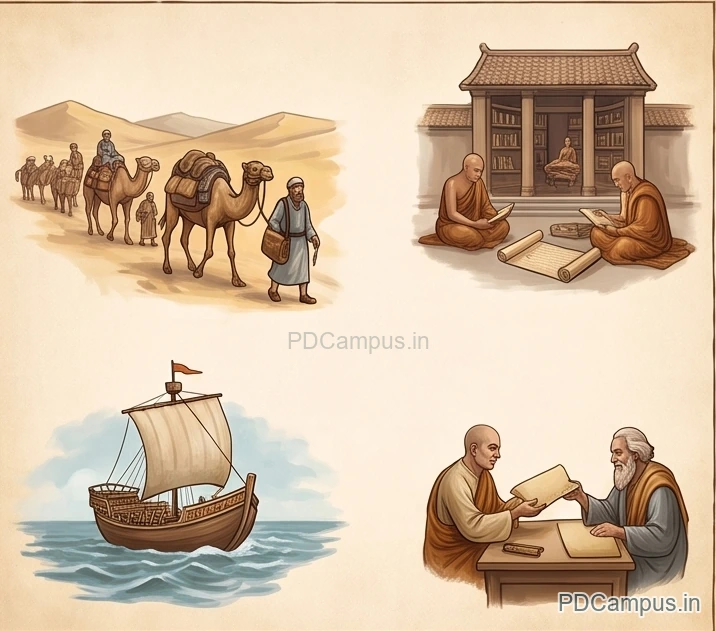
A teaching travels when people, routes and institutions carry it. Merchants funded caves and monasteries. Rulers protected centres. Monks and pilgrims moved along land and sea routes. Art turned ideas into forms people could see and remember.शिक्षा लोगों, रास्तों और संस्थाओं के साथ यात्रा करती है। व्यापारियों ने गुफाओं और मठों को दान दिया। शासकों ने केंद्रों को संरक्षण दिया। भिक्षु और यात्री स्थल तथा समुद्री मार्गों से चले। कला ने विचारों को देखने और याद रखने योग्य रूप दिया।
Dharma wheelधर्मचक्र
A Dharma wheel can symbolise teaching set in motion; eight spokes often recall the Eightfold Path. India’s national flag instead uses a 24-spoked Ashoka Chakra. Do not confuse a teaching diagram of eight path factors with the flag’s exact design.धर्मचक्र उपदेश के आगे बढ़ने का चिह्न हो सकता है; आठ तीलियाँ अक्सर अष्टांगिक मार्ग की याद दिलाती हैं। भारत के राष्ट्रीय ध्वज का अशोक चक्र 24 तीलियों वाला है। आठ मार्ग-अंगों के शिक्षण-चित्र को ध्वज की ठीक बनावट से न मिलाएँ।
Bodhi treeबोधिवृक्ष
Awakening at Bodh Gaya. A tree can mark the Buddha without showing a human figure.बोधगया में जागृति का संबंध। मानव आकृति दिखाए बिना भी वृक्ष बुद्ध की उपस्थिति का संकेत हो सकता है।
Footprints + empty throneपदचिह्न और खाली आसन
Presence through absence: the path walked and the seat of awakening or teaching.मानव आकृति के बिना उपस्थिति का संकेत: बुद्ध जिस मार्ग पर चले और ज्ञानप्राप्ति या उपदेश से जुड़ा आसन।
Lotus + deer + stupaकमल, हिरण और स्तूप
Purity; Deer Park at Sarnath; and a relic or memorial mound used for devotion and circumambulation.कमल शुद्धता, हिरण सारनाथ के मृगदाव और स्तूप अवशेष या स्मृति-टीले से जुड़ते हैं। स्तूप के पास श्रद्धा व्यक्त की जाती है और प्रदक्षिणा की जाती है।
Stupa, chaitya hall and viharaस्तूप, चैत्यगृह और विहार
A stupa is a sacred mound or monument associated with relics or commemoration. In common architectural usage a chaitya hall is a worship hall, often containing a stupa; chaitya can also mean a sacred shrine more broadly. A vihara is a monastic residence or monastery. A rock-cut complex may contain both residential cells and worship spaces. A statue, a stupa and a monastery serve related religious settings but are not the same kind of object.स्तूप अवशेषों या स्मरण से जुड़ा पवित्र टीला या स्मारक है। स्थापत्य के सामान्य प्रयोग में चैत्यगृह उपासना का कक्ष है, जिसमें अक्सर स्तूप होता है; चैत्य शब्द का व्यापक अर्थ पवित्र स्थान भी हो सकता है। विहार मठीय निवास या मठ है। चट्टान काटकर बने परिसर में रहने की कोठरियाँ और उपासना-स्थान दोनों हो सकते हैं। प्रतिमा, स्तूप और मठ संबंधित धार्मिक परिवेश में हैं, लेकिन एक ही प्रकार की वस्तु नहीं हैं।
Stupa cutaway - read the monument from bottom to topस्तूप के भाग: नीचे से ऊपर समझें
Sanchi’s Great Stupa began with an Ashokan brick foundation and was enlarged and decorated over later centuries. Toranas are gateways; the anda is the dome; the harmika is the small enclosure above it; the yashti is the mast and chhatras are its umbrella forms. A vedika is a railing. The pradakshina patha supports clockwise walking around the sacred centre. These parts belong to a developed stupa form, not every phase or every monument unchanged.साँची के महान स्तूप की शुरुआत अशोक के समय के ईंट-निर्माण से जुड़ी है। बाद की शताब्दियों में उसका विस्तार और अलंकरण हुआ। तोरण प्रवेशद्वार हैं; अंड गुंबद है; हर्मिका उसके ऊपर छोटा घेरा है; यष्टि दंड और छत्र उसके छतरी जैसे रूप हैं। वेदिका रेलिंग है। प्रदक्षिणापथ पवित्र केंद्र के चारों ओर घड़ी की दिशा में चलने का मार्ग है। ये विकसित स्तूप के भाग हैं; हर चरण और हर स्मारक में इनका रूप एक जैसा नहीं रहा।
Read a developed stupaविकसित स्तूप के भाग पहचानें
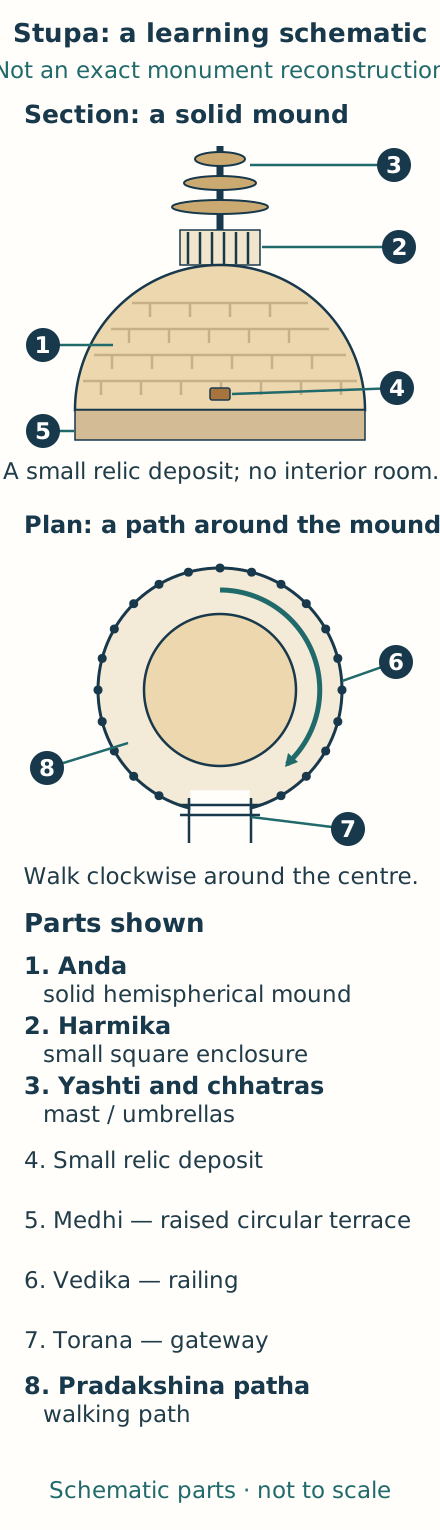
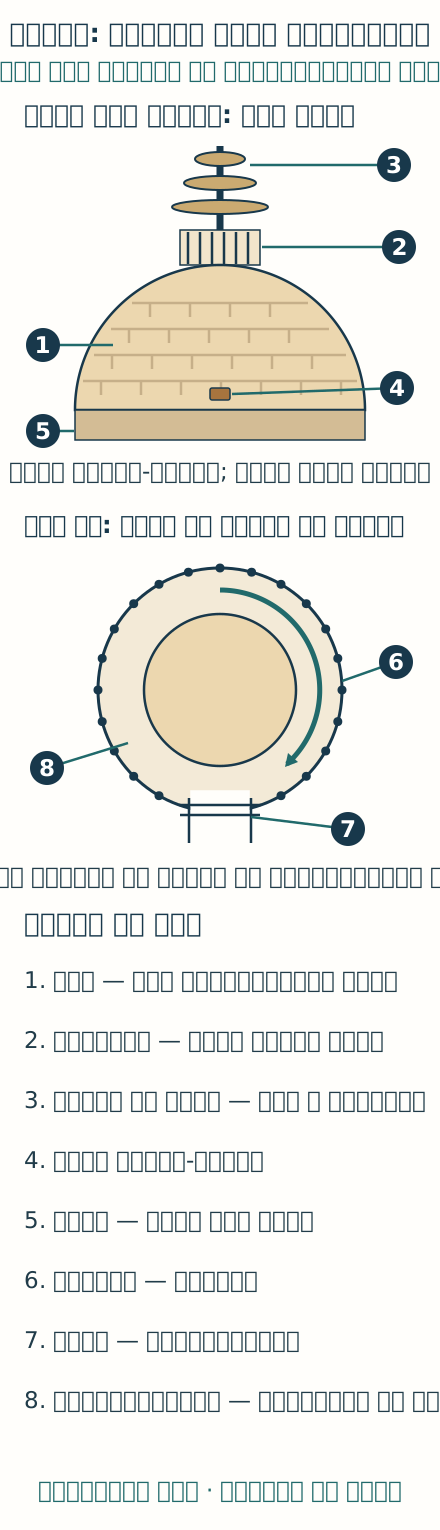
In a developed stupa such as Sanchi, medhi names the raised circular terrace or drum associated with the upper circumambulatory level. The harmika is the small square enclosure above the dome. These parts clarify the original schematic; construction and access vary by monument.साँची जैसे विकसित स्तूप में मेधि ऊँचे गोलाकार चबूतरे या आधार-भाग को कहते हैं, जो ऊपरी प्रदक्षिणा-स्तर से जुड़ा है। हर्मिका गुंबद के ऊपर बना छोटा चौकोर घेरा है। ये भाग मूल रेखाचित्र को समझाते हैं; अलग स्मारकों में निर्माण और प्रवेश-व्यवस्था भिन्न होती है।
Early symbolic artप्रारंभिक प्रतीकात्मक कला
At sites such as Bharhut and Sanchi, narratives often represent the Buddha by a wheel, Bodhi tree, throne, footprints or stupa. “Aniconic” means the Buddha is not shown in human form in that scene.भरहुत और साँची जैसे स्थलों के कथात्मक दृश्यों में बुद्ध को अक्सर चक्र, बोधिवृक्ष, आसन, पदचिह्न या स्तूप से दिखाया गया है। अनाइकोनिक का अर्थ है कि उस दृश्य में बुद्ध मानव रूप में नहीं दिखाए गए हैं।
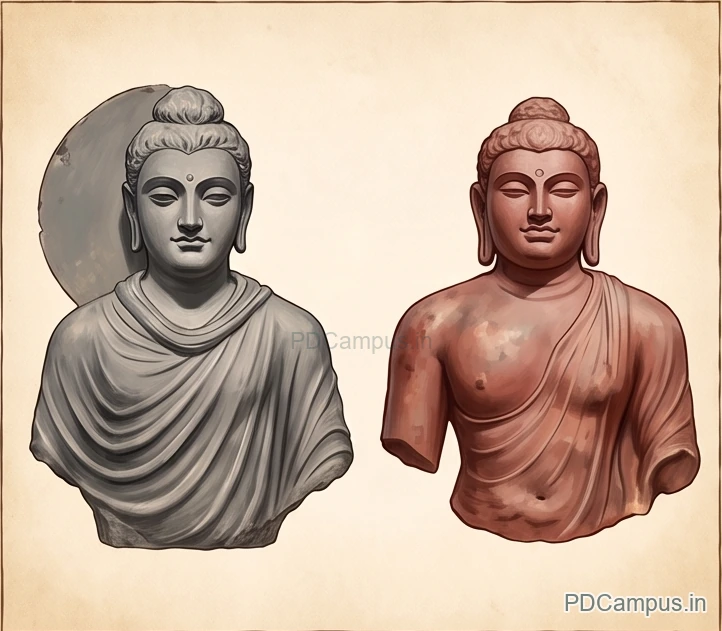
Gandharaगांधार
Gandhara was a north-western artistic region. Grey schist sculptures, deeply folded robes and forms shaped through Indian, Iranian and Hellenistic contacts are useful identifying clues. Artists also used other materials, including stucco; grey stone is not a rule for every Gandharan work. The region produced many Buddha and bodhisattva images. Schist is a layered metamorphic rock; stucco is a plaster-like modelling material. Hellenistic here refers to traditions shaped by Greek cultural influence.गांधार उत्तर-पश्चिम का कलाक्षेत्र था। धूसर शिस्ट की मूर्तियाँ, गहरी सिलवटों वाले वस्त्र और भारतीय, ईरानी तथा हेलेनिस्टिक संपर्कों से बने रूप पहचान के उपयोगी संकेत हैं। कलाकार स्टुको सहित दूसरी सामग्री भी इस्तेमाल करते थे; हर गांधार कृति धूसर पत्थर की नहीं है। यहाँ बुद्ध और बोधिसत्त्व की अनेक प्रतिमाएँ बनीं। शिस्ट परतदार कायांतरित चट्टान है; स्टुको पलस्तर जैसी आकृति गढ़ने की सामग्री है। यहाँ हेलेनिस्टिक का अर्थ यूनानी सांस्कृतिक प्रभाव से बनी परंपराएँ हैं।
Mathuraमथुरा
North Indian school using mottled red sandstone, strong frontal bodies and local sculptural traditions. It produced Buddhist, Jain and Brahmanical images.उत्तर भारतीय शैली में चित्तीदार लाल बलुआ पत्थर, सामने की ओर मजबूत देह-आकृतियाँ और स्थानीय मूर्तिकला परंपराएँ मिलती हैं। यहाँ बौद्ध, जैन और ब्राह्मणीय प्रतिमाएँ बनीं।
Art caution: do not claim that Kanishka “invented” Buddha images or that Gandhara alone made the first one. Human images became prominent in both Gandhara and Mathura during the early centuries CE; their exact priority is debated.कला में सावधानी: यह न कहें कि कनिष्क ने बुद्ध की प्रतिमा का आविष्कार किया या पहली प्रतिमा केवल गांधार में बनी। शुरुआती ईस्वी शताब्दियों में गांधार और मथुरा दोनों में मानव रूप की प्रतिमाएँ प्रमुख हुईं; ठीक-ठीक प्राथमिकता विवादित है।
Two artistic regions, overlapping historiesदो कलाक्षेत्र, साथ चलते इतिहास
Patronage and spread - people make the map moveसंरक्षण और प्रसार: लोगों के साथ विचार चलते हैं
| Carrier or patronप्रसारक या संरक्षक | What the connection meansसंबंध का अर्थ | Do not overstateक्या बढ़ा-चढ़ाकर न कहें |
|---|---|---|
| Early rulers and donorsशुरुआती शासक और दाता | Bimbisara, Ajatashatru and other regional elites appear in Buddhist traditions; merchants, guilds, women and ordinary lay donors funded establishments.बौद्ध परंपराओं में बिंबिसार, अजातशत्रु और क्षेत्रीय प्रभावशाली लोग आते हैं; व्यापारियों, श्रेणियों, महिलाओं और साधारण गृहस्थों ने भी दान दिया। | Buddhism did not spread only from kings downward.बौद्ध धर्म केवल राजाओं के आदेश से नीचे की ओर नहीं फैला। |
| Ashokaअशोक | Mauryan patronage, pillars, stupas and inscriptions connected Dhamma with imperial communication. Buddhist chronicles associate his time with missions and Mahinda/Sanghamitta in Sri Lanka.मौर्य संरक्षण, स्तंभ, स्तूप और अभिलेखों ने धम्म को साम्राज्य के संचार से जोड़ा। बौद्ध इतिहास-वृत्त उनके समय को श्रीलंका में महिंद और संघमित्रा तथा अन्य प्रचार-यात्राओं से जोड़ते हैं। | Ashoka's Dhamma in inscriptions is a broad ethical policy, not a simple copy of all Buddhist doctrine.अभिलेखों का अशोक-धम्म व्यापक नैतिक नीति है, पूरे बौद्ध सिद्धांत की सरल प्रतिलिपि नहीं। |
| Indo-Greek and Kushana worldsहिंद-यूनानी और कुषाण संसार | Menander is linked with Milindapanha; Kanishka with northern Buddhist patronage, Kashmir council tradition and networks into Central Asia.मेनांडर मिलिंदपञ्ह से; कनिष्क उत्तरी बौद्ध संरक्षण, कश्मीर संगीति-परंपरा और मध्य एशिया के संपर्कों से जुड़े हैं। | Later accounts and exact personal conversions need attribution.बाद के विवरण और व्यक्तिगत धर्म-परिवर्तन के निश्चित दावे स्रोत सहित बताएँ। |
| Trade routesव्यापार मार्ग | Monasteries near roads, passes, ports and cities offered learning and shelter; merchants carried gifts, stories and ideas.सड़कों, दर्रों, बंदरगाहों और नगरों के पास मठ शिक्षा और आश्रय देते थे; व्यापारी दान, कथाएँ और विचार ले जाते थे। | A route enables movement; it does not prove every traveller was Buddhist.मार्ग आवागमन संभव बनाता है; इससे हर यात्री बौद्ध सिद्ध नहीं होता। |
| Harsha and Pala rulersहर्ष और पाल शासक | Later patronage supported monasteries and universities such as Nalanda, Vikramashila, Odantapuri and Somapura; scholars linked India with Tibet and East Asia.बाद के संरक्षण से नालंदा, विक्रमशिला, ओदंतपुरी और सोमपुर जैसे मठ और अध्ययन-केंद्र चले; विद्वानों ने भारत को तिब्बत और पूर्वी एशिया से जोड़ा। | Centres and traditions overlapped; they were not one uniform university system.केंद्र और परंपराएँ एक-दूसरे से मिलते थे; वे एक समान विश्वविद्यालय प्रणाली नहीं थे। |
| Pilgrims and translatorsयात्री और अनुवादक | Faxian, Xuanzang and Yijing travelled to India; translators and teachers moved texts into Chinese, Tibetan and other languages.फाह्यान, ह्वेनसांग और इत्सिंग भारत आए; अनुवादक और शिक्षक ग्रंथों को चीनी, तिब्बती तथा अन्य भाषाओं में ले गए। | Their records describe particular journeys and periods, not every century.उनके विवरण खास यात्राओं और कालों के हैं, हर शताब्दी के नहीं। |
Remember a network over many centuries: from the Ganga region into northwestern South Asia, through Central Asian routes towards China, and onward through connections with Korea and Japan; separate Himalayan connections involved Tibet, while southern and sea routes linked Sri Lanka and Southeast Asia. This is a schematic direction of transmission, not one journey, a political border map or a claim that every region received Buddhism through a single route.कई शताब्दियों का जाल याद रखें: गंगा क्षेत्र से उत्तर-पश्चिमी दक्षिण एशिया, मध्य एशियाई मार्गों से चीन और आगे कोरिया तथा जापान से संपर्क; अलग हिमालयी संपर्क तिब्बत से जुड़े, जबकि दक्षिणी और समुद्री मार्गों ने श्रीलंका तथा दक्षिण-पूर्व एशिया को जोड़ा। यह प्रसार की दिशा समझाने का संकेत है, एक यात्रा, राजनीतिक सीमाओं का नक्शा या हर क्षेत्र में केवल एक मार्ग से धर्म पहुँचने का दावा नहीं।
Keep patrons and centres in their own centuriesसंरक्षकों और केंद्रों का समय अलग पहचानें
Nalanda’s major monastic teaching institution flourished from the 5th to the 13th centuries CE, with Gupta and later patronage. Harsha supported Buddhism in the 7th century, while the Pala rulers supported major eastern monasteries in subsequent centuries. Do not infer that Harsha founded or supported every later Pala foundation merely because their names appear in one table. Mahinda and Sanghamitta belong to Sri Lankan transmission traditions associated with Ashoka, not to the much later Nalanda pilgrim period.नालंदा का प्रमुख मठीय शिक्षण संस्थान गुप्त और बाद के संरक्षण में पाँचवीं से तेरहवीं शताब्दी ईस्वी तक फला-फूला। हर्ष सातवीं शताब्दी में बौद्ध धर्म के संरक्षक थे; बाद की शताब्दियों में पाल शासकों ने पूर्वी भारत के बड़े मठों को संरक्षण दिया। एक तालिका में नाम साथ आने से यह न मानें कि हर्ष ने पालों के समय के हर बाद के केंद्र की स्थापना या सहायता की थी। महिंद और संघमित्रा अशोक से जुड़ी श्रीलंकाई प्रसार-परंपरा में आते हैं, बहुत बाद के नालंदा-यात्री काल में नहीं।
People and institutions carried teachingलोगों और संस्थाओं से शिक्षा आगे बढ़ी
Why Buddhism declined in much of India - a gradual cause webभारत के बड़े हिस्से में ह्रास: कई कारणों का संबंध
Buddhism did not vanish from India on one day. Patronage changed; Brahmanical and Bhakti traditions expanded and absorbed some practices and sacred figures; some monasteries depended on large endowments; trade patterns shifted; and links between monastic centres and local lay communities varied. Historians weigh these factors differently. Attacks on major Bihar monastic institutions around the late 12th and early 13th centuries caused serious disruption, but they do not explain every region’s earlier or later history. Buddhism continued in Himalayan, eastern and other communities and later experienced modern revivals.भारत में बौद्ध धर्म एक दिन में समाप्त नहीं हुआ। संरक्षण बदला; ब्राह्मणीय और भक्ति परंपराएँ बढ़ीं और कुछ अभ्यासों तथा पवित्र व्यक्तियों को अपने भीतर शामिल किया; कुछ मठ बड़े दानों पर निर्भर थे; व्यापार के रास्ते बदले और मठों के स्थानीय गृहस्थ समुदायों से संबंध अलग-अलग रहे। इतिहासकार इन कारणों का महत्व अलग तरह से आँकते हैं। लगभग बारहवीं शताब्दी के अंत और तेरहवीं के आरंभ में बिहार के बड़े मठीय संस्थानों पर हमलों से गंभीर व्यवधान हुआ, लेकिन इससे हर क्षेत्र का पहले या बाद का इतिहास नहीं समझाया जा सकता। हिमालयी, पूर्वी और अन्य समुदायों में बौद्ध धर्म जारी रहा तथा बाद में आधुनिक पुनरुत्थान भी हुए।
5. Rapid Revision Data - One Connected Memory Page5. त्वरित दोहराव: तथ्यों को जोड़कर याद करें
Revise Buddhism as one sentence: a Shakya seeker awakened at Bodh Gaya, diagnosed dukkha, taught a Middle Way, formed a Sangha, and his teaching travelled through councils, texts, patrons, art and Asian routes.एक वाक्य में दोहराएँ: शाक्य समुदाय के एक साधक ने बोधगया में जागृति प्राप्त की, दुःख को समझाया, मध्यम मार्ग सिखाया और संघ बनाया; उनकी शिक्षा संगीतियों, ग्रंथों, संरक्षकों, कला तथा एशियाई मार्गों से आगे बढ़ी।
Four life placesजीवन के चार स्थान
- Lumbini - birthलुंबिनी — जन्म
- Bodh Gaya - awakeningबोधगया — जागृति
- Sarnath - first sermonसारनाथ — पहला उपदेश
- Kushinagar - final passingकुशीनगर — अंतिम निर्वाण
Four Truthsचार सत्य
- Dukkhaदुःख
- Craving as originतृष्णा के रूप में उत्पत्ति का कारण
- Cessationनिरोध
- Eightfold Pathअष्टांगिक मार्ग
Three trainingsतीन प्रशिक्षण
- Wisdomप्रज्ञा
- Ethical conductनैतिक आचरण
- Mental disciplineमानसिक अनुशासन
- These three trainings support one another; this final line is a reminder, not a fourth training.ये तीनों प्रशिक्षण एक-दूसरे की सहायता करते हैं; अंतिम पंक्ति स्मरण है, चौथा प्रशिक्षण नहीं।
Three Jewelsतीन रत्न
- Buddha - teacherबुद्ध — शिक्षक
- Dhamma - teachingधम्म — शिक्षा
- Sangha - communityसंघ — समुदाय
- The refuge formula names these three; it is not a fourth jewel.शरण का सूत्र इन्हीं तीनों का नाम लेता है; वह चौथा रत्न नहीं है।
| If you see...यह दिखे तो... | Connect it immediately to...तुरंत किससे जोड़ें | Keep this distinction clearअंतर स्पष्ट रखें |
|---|---|---|
| Maya / Mahaprajapati / Suddhodanaमाया / महाप्रजापती / शुद्धोदन | Mother / foster mother and aunt / father of Siddhartha in tradition.परंपरा में सिद्धार्थ की माता / पालक माता और मौसी / पिता। | Siddhartha is the traditional given name; Gautama is a family or clan name; Buddha is a title.सिद्धार्थ परंपरागत व्यक्तिगत नाम है; गौतम परिवार या कुल का नाम और बुद्ध उपाधि है। |
| Sujata / Bodhi tree / Vajrasanaसुजाता / बोधिवृक्ष / वज्रासन | Meal after extreme asceticism / awakening tree / diamond throne at Bodh Gaya.कठोर तप के बाद भोजन / जागृति का वृक्ष / बोधगया का वज्रासन। | Middle Way rejects both indulgence and self-torture.मध्यम मार्ग भोग और आत्म-पीड़ा दोनों अतियों को छोड़ता है। |
| Deer Park / five asceticsमृगदाव / पाँच तपस्वी | First sermon at Sarnath; wheel of Dhamma set in motion.सारनाथ का पहला उपदेश; धम्म का चक्र चलना। | Awakening happened earlier at Bodh Gaya.जागृति इससे पहले बोधगया में हुई। |
| Ananda / Upali / Mahakassapaआनंद / उपालि / महाकस्सप | Teaching recitation / Vinaya recitation / First Council leadership in tradition.परंपरा में उपदेशों का पाठ / विनय का पाठ / पहली संगीति का नेतृत्व। | Council narratives come from later lineages.संगीति की कथाएँ बाद की वंश-परंपराओं से मिली हैं। |
| Rajagriha / Vaishali / Pataliputraराजगृह / वैशाली / पाटलिपुत्र | First / Second / Third council traditions.पहली / दूसरी / तीसरी संगीति की परंपराएँ। | Kashmir and Sri Lanka preserve different “Fourth Council” traditions.कश्मीर और श्रीलंका की चौथी संगीति की परंपराएँ अलग हैं। |
| Moggaliputta Tissaमोग्गलिपुत्त तिस्स | Theravada account of Ashoka's Third Council.अशोक की तीसरी संगीति का थेरवाद विवरण। | Ashoka's ethical Dhamma and full Buddhist doctrine are not identical labels.अशोक का नैतिक धम्म और पूरा बौद्ध सिद्धांत एक ही नाम नहीं हैं। |
| Vasumitra / Kanishkaवसुमित्र / कनिष्क | Northern Fourth Council tradition at Kundalavana, Kashmir; Sarvastivada commentary.कश्मीर के कुंडलवन की उत्तरी चौथी संगीति-परंपरा; सर्वास्तिवाद की व्याख्याएँ। | Mahayana developed gradually, not at one meeting.महायान धीरे-धीरे विकसित हुआ, किसी एक सभा में नहीं। |
| Pali Tipitakaपालि तिपिटक | Vinaya, Sutta and Abhidhamma baskets.विनय, सुत्त और अभिधम्म पिटक। | Other early canons and later Mahayana/Vajrayana texts also exist.दूसरे शुरुआती ग्रंथ-संग्रह और बाद के महायान / वज्रयान ग्रंथ भी हैं। |
| Wheel / tree / throne / footprintsचक्र / वृक्ष / आसन / पदचिह्न | Early symbolic representations associated with Buddha and teaching.बुद्ध और शिक्षा से जुड़े शुरुआती प्रतीकात्मक रूप। | Human Buddha images became prominent in Gandhara and Mathura.गांधार और मथुरा में मानव रूप की बुद्ध प्रतिमाएँ प्रमुख हुईं। |
| Anda / harmika / yashti / chhatraअंड / हर्मिका / यष्टि / छत्र | Parts of a stupa from dome to upper umbrella mast.गुंबद से ऊपरी छतरी-दंड तक स्तूप के भाग। | Torana is the gateway; vedika the railing; pradakshina the clockwise path.तोरण प्रवेशद्वार, वेदिका रेलिंग और प्रदक्षिणा घड़ी की दिशा में घूमना है। |
| Mahinda / Sanghamittaमहिंद / संघमित्रा | Sri Lankan chronicle tradition of transmission during Ashoka's age and the Bodhi-tree branch.श्रीलंका के इतिहास-वृत्तों में अशोक-युग का प्रसार और बोधिवृक्ष की शाखा। | Mission accounts are preserved by a particular historical tradition.धर्म-प्रचार के विवरण एक खास ऐतिहासिक परंपरा में सुरक्षित हैं। |
| Nalanda / Vikramashilaनालंदा / विक्रमशिला | Major monastic learning centres; later links with East Asia and Tibet.बड़े मठीय अध्ययन-केंद्र; बाद में पूर्वी एशिया और तिब्बत से संबंध। | Their destruction accelerated decline but did not single-handedly cause it.उनके विनाश से ह्रास तेज हुआ, लेकिन वह अकेला कारण नहीं था। |
Life: L-B-S-Kजीवन-स्थान: L–B–S–K
L-B-S-K recalls the four places: Lumbini, Bodh Gaya, Sarnath and Kushinagar.L-B-S-K से चार स्थान याद करें: लुंबिनी, बोधगया, सारनाथ और कुशीनगर।
Lumbini - Bodh Gaya - Sarnath - Kushinagar.लुंबिनी — बोधगया — सारनाथ — कुशीनगर।
Path groups: W-E-Mमार्ग के समूह: W–E–M
W-E-M recalls wisdom, ethical conduct and mental training.W-E-M से प्रज्ञा, नैतिक आचरण और मानसिक प्रशिक्षण के तीन समूह याद करें।
Wisdom - Ethics - Mental discipline.प्रज्ञा — नैतिकता — मानसिक अनुशासन।
Baskets: V-S-Aपिटक: V–S–A
V-S-A recalls discipline, discourses and analysis.V-S-A से अनुशासन, उपदेश और विश्लेषण के विषय याद करें।
Vinaya - Sutta - Abhidhamma.विनय — सुत्त — अभिधम्म।
Final accuracy strip: Buddha's exact dates are debated; the Four Sights are biographical tradition; anatta is not a permanent soul doctrine; nirvana is not merely heaven; councils are lineage traditions; Mahayana was gradual; Theravada should not be reduced to the polemical word Hinayana; early Buddha-image priority is debated; Ashoka's Dhamma is broader than a sectarian creed; and decline in India was regional, gradual and multi-causal.अंतिम सावधानियाँ: बुद्ध की निश्चित तारीखों पर मतभेद हैं; चार दृश्य जीवन-कथा की परंपरा हैं; अनत्ता स्थायी आत्मा का सिद्धांत नहीं; निर्वाण केवल स्वर्ग नहीं; संगीतियाँ वंश-परंपराओं के विवरण हैं; महायान क्रमिक रूप से बना; थेरवाद को विरोध में इस्तेमाल हुए हीनयान शब्द तक सीमित न करें; पहली मानव बुद्ध प्रतिमा की प्राथमिकता विवादित है; अशोक का धम्म संप्रदाय-विशेष के मत से व्यापक है; भारत में ह्रास क्षेत्रीय, क्रमिक और कई कारणों वाला था।
Buddhism is easiest to remember as a living chain: understand the condition, remove its fuel, practise the path, and help the teaching travel.बौद्ध धर्म को जुड़ी कड़ियों की तरह याद करें: अवस्था समझना, उसका ईंधन हटाना, मार्ग का अभ्यास करना और शिक्षा को आगे पहुँचाना।